Monday, 12 June 2023

Videos: the gap between teaching and learning


Two years after I retired I stepped back into the hobby I had enjoyed as a schoolboy but had felt obliged to set aside in favour of ‘getting on with life’. (There’s a whole blog series buried in that phrase, but it’ll not be written by me … unless some of my earlier posts, like this one, cover some of those bases.) I’d been saying for years and years that I missed it and had long declared that I would spend a fraction of my pension pay-out in order to get the telescope that I’d always wanted as a teenager. With hindsight, a useful rejoinder might have been “be careful what you wish for”.

Cutting a long and convoluted story short (more details here should you wish to know; if you’re having trouble sleeping there are also a few updates*) I finally put my money where my schoolboy aspiration lay and bought a 150 mm Newtonian reflector from a local supplier, which sat beautifully upon a sturdy tripod and equatorial mount. Patrick Moore would have used the old-style measurement of six inches back when I was a kid watching ‘Sky at Night’ on a low resolution monochrome TV – this was the size he’d recommended and it had evidently lodged in my mind for more than half a century. It was lovely; so much fun. I spent the first hours of many a clear night gazing through it at all those objects I’d struggled to see using my original tiny pocket-money telescope. However, the more I gazed the more my aspirations grew. Unfortunately, the associated challenges seemed at times to expand even faster.
Here it is: one of the most fun presents I’ve ever treated myself to, fresh out of the box and assembled indoors awaiting better weather, and darkness.

The core issue was that I wanted to capture images of what I was looking at, and in the process to go beyond the limitations of my eyes – which the attributes of a superbly flexible short focal length ‘camera’, but limited by a relatively inefficient light capture mechanism. I tried to use my smartphone, but with limited success. The next step was to persuade family members to buy me an entry-level astronomical camera as a Christmas present – but that also necessitated retro-fitting motorized drives to my equatorial mount and loading (and learning to run) a whole family of software packages on my PC. All this software requires effort if it is to be used to the full and it was at this point that my attempts to learn from blog sites and YouTube began.

“YouTube is your friend” was a mantra cited by several people at my local amateur astronomy society. (Sadly, their meetings are held at a venue which is over an hour’s drive away: a journey I don’t attempt these days, although I can get to the much closer Beacon Observing Group - but that's not quite the same thing.) There’s certainly a lot of relevant material there, along with copious bite-sized snippets of advice on astronomy-related Facebook groups and the like (e.g. Altair Astro's). I muddled through on this basis and in the process collected a few pleasing images of major solar system objects, along with a few binary star systems. I still haven’t captured an image of Mercury, but that’s another story. However, this learning curve was insignificant compared to the issues associated with my deeper aspiration of capturing images of nebulæ within the Milky Way and more particularly images of other galaxies. Another telescope, a computerized mount and a second astrocam were required. Actually, a pair of telescopes was needed: a small one to piggy-back on the main ’scope in order to control the mount so that the main telescope+astrocam holds the target object steady in the field of view for extended periods of time. This is where the limitations of trying to learn something from online sources really kicked in since the technical demands on setting up the assembled equipment are severe and the slew of new software to get to grips with (and to get in communication with the equipment!) is prodigious. There is so much to learn and to master; even if astrophotography was my only hobby or commitment I would struggle to set aside enough time.
This is the ‘new’ setup – actually, both the telescope and the astrocam (the larger of the two purple cylinders where otherwise an eye might be) were purchased second-hand from trustworthy people – photographed during a session of daytime astronomy whilst imaging sunspot clusters. Getting used to the new kit in the light was extremely useful, although it can never resolve the issues associated with long-exposure imaging. (It's taken me by surprise a little bit how difficult I'm finding this given that I spent an entire career writing and using complex software in order to handle large datasets and get something meaningful out the other side. An acquaintance - himself an experienced astronomer and astrophotographer with his own observatory - recently described it as being 'rocket surgery'; he's not wrong. Perhaps it's an age thing ...)

Online is usually the only place to go for information since ‘deep sky’ astrophotography is intrinsically a solo pursuit (i.e. suitable for introverts). Having said that, there are a handful of people who have offered useful bespoke advice via email or similar - people like Ewan who I met at the local astronomy society I mentioned earlier, and like Alex at First Light Optics. Nevertheless, I’d dearly love to have an experienced person nearby who’d be willing to spend an evening or two giving me a tutorial – but even those few I know with a nearby postcode use different kit and more importantly, different software packages. So, I’m back online again.

This is probably true of all hobbies, but search for topics in ‘astrophotography’ on YouTube and you’ll be met with an ocean of suggested videos, many of which have words like ‘beginners’ and ‘tutorial’ in their titles. They are tags I have learnt not to rely on. For every instructional video that tackles beginners’ issues well – i.e. none of those frustrating missed steps or the use of jargon etc. – one might have waded through another five that confuse or even demotivate. On some topics I have failed to find a single video that addressed my questions and therefore that I’d recommend to another struggling beginner. Don’t get me wrong, I admire and am grateful to these people for at least making the effort. Moreover, most of their videos contain nuggets of useful information and I’m confident that, should I ever move on from my present inexperienced state, some will be of use as I seek to progress further. I’m also acutely aware of my own limitations, having uploaded many hours of physics-related video material during the more severe phases of the COVID pandemic. These were notionally aimed at my local u3a (University of the Third Age) and specifically for those with a non-science background: see here and also here. I have already been told by a couple of people that I ‘lost’ them in some instances – for them, at the very least, I failed to deliver. I had attempted to teach something, but those viewers had not been able to learn from the material I supplied. That’s down to me, not to them. Thus, even someone like me who used to teach for a living – and do it well by most accounts# – found it difficult. It was easier when I was in the lecture theatre, face-to-face with students and thus able to fine-tune my words in real-time as I responded to the learners in front of me. Such responsiveness is simply not possible when limited to the one-shot nature of a YouTube video and its analogues. Or is it …?

These reflections have suggested to me a way forward which might work were it practicable – which, unfortunately, it probably isn’t without time-consuming effort, coordination and sponsorship. What if one were able to bring together an experienced practitioner and one or two (or more) beginners and film the interaction as our expert got the beginners up-and-running. The expert has the resources needed and the beginners will keep the pace and details at an appropriate level. If none of them has simultaneously to handle the filming/editing process then such matters as line-of-sight, clarity of shots, sound levels etc. can better be assured. Thus, we have a team effort; expensive of time etc. but potentially better able to generate something of worth. Of course, this would be a long series of videos since one would need to cover a wide spectrum of tasks using various combinations of equipment and software.

It’s a dream, nothing more.
______________________________________________________________


* here, oh and here and also here ;-)

# Please forgive me if this sounds boastful. In truth, I have never felt completely satisfied with my skill as a teacher and I know I have made mistakes, but I look back on decades of complimentary feedback from students and can smile nevertheless at a job done to the best of my ability.


Saturday, 11 March 2023

Lost, and found again: the Graveney boat and me.


By my reckoning, I was seventeen. Reverse the digits and you’ll arrive at my age on my next birthday. I was, in a great many respects, another person; a person who so easily might have chosen, or have stumbled through a doorway other than the one I actually took, ending up who-knows-where.

A model of the clinker-built late ninth century ‘Graveney Boat’ displayed within the Fleur de Lis museum in Faversham – almost on my doorstep, but only visited recently in the company of my teenage grandsons (who are ‘collecting’ the fifty or so small independent museums in our region … as one does.) When I saw this tiny model in its display case I couldn’t help but smile; read on to find out why.


I’ve mentioned serendipity – perhaps that ought to be providence – many times in my posts (e.g. in the first post of a short series reflecting on my career as a scientist, here) but a recent visit to the Fleur de Lis museum in Faversham provided a rather joyful reminder of its potential. Back in the day, I used to volunteer my weekends as a helper on local archaeological excavations. We’d be picked up early in the morning and driven to wherever there was a need for ‘emergency archaeology’, by which I mean the desire to uncover artefacts and learn as much as one could in the limited time before a developer’s bulldozers moved in. Some years would elapse before such sites/finds were afforded protection under law (see here and here) so it really did feel like a valuable and an exciting thing to do. Also, I was a seventeen year old with zero interest in sports – chronic asthma at a time when treatments were limited, two left feet and distinctly bookish tendencies coupled with a well-developed inferiority complex – but with the usual innate need to be doing ‘something’. Volunteering in this way fitted the bill perfectly: an inexhaustible excuse for reading, small groups of like-minded people and working outdoors in out-of-the-way locations. As a bonus, my dad was a bricklayer and so the instruction to bring your own pointing trowel was easy to follow. What’s not to love?

Pursuing archaeology as a career appealed to me a great deal. At this distance from the person I was back then I cannot begin reliably to reconstruct the thought processes that steered me towards studying physics and then beginning chemical physics research. The existence of radiocarbon dating techniques and the later introduction of geophysical probes like resistivity and magnetometry would only serve to heighten my interest, but by then archaeology had become an armchair hobby overshadowed by my fascination with the physical sciences. (The line became blurred a little during the final years of my professional career when I was able to use my chemical physics expertise to make a small contribution to heritage/conservation projects: see here, here and here.)

I only volunteered for one season in 1970 (maybe a little in 1969? – other priorities, like final school exams and university applications, squeezed it out thereafter) but the joy of taking part has stayed with me ever since. Having said that, you may be surprised when I admit that, somewhere along the line, I forgot the associated details. I could always have told you that our mentor in this voluntary work was enthusiastic archaeologist Mr. Jim Bradshaw (who died in 2001); he was a good person to learn from as I recall. I also remember that the two multi-weekend digs I took part in during this period were poles apart in their nature: well-drained flat farmland abutting an oil depot which was hiding a Romano-British residential/industrial site, and mud-up-to-the-armpits marshland which revealed a ninth century boat. In one case, the land would return to being farmed and the other was in the way of a major drainage channel.

The Romano-British site (see the 1990 aerial image below, with links) had apparently been known about for several decades, with bits of pottery being turned up by the plough now and again. More excavations were conducted nearby in the decades following my involvement and within a much better framework of legal protection than the one I was a part of. (These later digs were as a prelude to the deserted oil depot’s removal in favour of housing.) I remember exposing a hearth – a flat patch of hard reddened soil in essence – and being shown how to distinguish ‘random’ chunks of flint, found in abundance in the region, from the remains of an ancient drystone wall or a well-constructed path. However, the highlight was exposing a small but whole clay jar. I had Mr. Bradshaw and a few others clustered around me as I was talked through the safe way to excavate and lift it. The best guess at the time was that it had once contained perfume.

This aerial image of the location of the Wye Romano-British site was taken in 1990, before later development and the excavations that preceded it. Further information may be found in reports submitted by Mr. Bradshaw and by those making reference to his work: here from 1970 in Section II, here from 2016 from 2016 and here in paragraph 2.2 from a national archive.

As you’ll no doubt recall, what prompted this post in the first place, and the online research undertaken in order to write it, was the happy accident of finding mention of ‘The Graveney Boat’ during my extended exploration of Faversham’s Fleur de Lis museum. (The Graveney Marshes, I ought to explain, are sited between Faversham and the North Kent coast (UK); there is also a village of Graveney.) None of the images I could find do justice to the mud; nor do they convey the camaraderie that coping with it engendered. However, I’ve included one below along with a slew of links to associated news items and formal reports; this was, without doubt, a big deal. Whilst at the museum I had a brief conversation with someone working there during which I asked about the fate of the boat. She informed me that The National Maritime Museum, who had taken overall charge of the project and had all the recovered material sent to them at the time, still retained the excavated timbers. Apparently, it’s still being stored under water as there are no funds to conserve it further – let alone to repatriate it to the nearby Faversham museum. Having been involved in a small way with the conservation of Henry VIII’s famous warship ‘The Mary Rose’ (here) I must admit that I felt very sad that funds didn’t exist to allow the excellent marine conservation resources in Portsmouth to be brought into play. C’est la vie, I suppose.

The images above are both taken from a 1971 paper in a publication called ‘Antiquity’; there’s another paper, less easy to access, published the following year in ‘Studies in Conservation’. Perhaps the feel of the place and the excavation work required is better conveyed in this (pre-HD) video, available via the Fleur de Lis museum’s web site.

All-in-all, I’ve had a pleasant trip down Memory Lane and had great fun piecing back together again the details of my season in the field as a volunteer archaeologist – a career path never trodden.


Wednesday, 11 January 2023

It’s got holes in it!


What do you see when you look at the Moon?

If you live with high levels of light pollution from streetlamps or commercial buildings or an annoying floodlight on a neighbour’s house – all of which are significant problems – then the Moon may be one of the few celestial object you can bank on seeing in the night sky. It’s a reliable presence whether we’re in the middle of town or the depths of the countryside. So, what do you see? A bright disk/crescent with some darker patches; perhaps you also notice a few curved lines?

A couple of weeks before Christmas I had the opportunity of showing more than fifty 9-10 year-olds* and their teachers what the (daytime) Moon looks like through a telescope. A handful told me that they had an older sibling or a parent with a telescope, but for most this was evidently a wholly new experience. In a brief introduction inside their warm school building – it was -2ºC outside – I’d suggested two or three things they might look out for: the lava fields/‘seas’ for sure, but also the distinct curve of the lunar Alps and the nearby crater named after Archimedes. For the majority, the first-timers, they all – and I do mean ALL – seemed to find the experience quite special, almost magical in some cases. Some of their reactions were priceless; three or four of them looked, looked again and then told me that the Moon had holes in it, which was a novel way to describe lava seas and deep craters. One or two uttered something I pretended not to hear, but which made me chuckle inside nevertheless.
Although not taken on the day, or even through the same telescope, this is similar to the view everyone would have had of the Moon during our morning session. I’ve added a few labels, including the Apollo 11 landing site, to make it easier to orient ourselves. For a good quality lunar map I have installed ‘LunarMapHD’ on my phone.

In order to avoid having anyone get too cold – anyone other than me and the member of staff with me that is – there were only eight pupils out there at any one time and they were all wrapped up against the chill. Finally, the staff members also had a chance to take a peek before we bundled back inside for an extended and wonderfully lively Q&A session. As with my visit to the school towards the end of the last academic year, when the previous Year 5 classes had the chance safely to observe sunspots (see here), the questions posed were far-ranging and challenging. More than once I had to say that I didn’t have an answer, but on the whole we were able to cover a lot of ground to everyone’s satisfaction. Some of the questions opened up important generic topics like the nature of science and the need to make decisions based on the best available evidence, whereas others were a lot more specific. In that latter camp there were many which arose from what they’d observed: what are the darker areas and why are there fewer craters within them; why are there some areas that seem particularly bright; how did the Moon form …? (Answers below.) We also explored the lifetime of stars, exoplanets and a question that arose at least three times in one guise or another: why are the planets different colours?
This is a composite image of a few of the morning's lunar observers; such a great bunch. (The images are included with appropriate consent and permissions having been obtained.)

All-in-all I was deeply impressed by the degree of their engagement and by their perceptive and well-phrased questions. I suspect that there are several budding scientists in their number, and I wish them well.
Happy lunar observing everyone 😀.

____________________________________

* I absolutely must mention the warm and enthusiastic welcome I got at The Churchill School which included the help of two class members, Teddy-Rose and Lewis (see image below, reproduced with appropriate permissions): with great care they helped me to ferry my equipment from the car to the playground we’d be using. The staff were amazing, and filled me with confidence that these children were in the best of hands: thank you for the invitation Mrs. Newport (yes, well spotted: the best of daughters-in-law) and thank you to your colleagues: Mr. Moore, who braved the cold with me in order to take photographs, Mrs. Lejeune and Mrs. Coleman. Also, many thanks to the school’s Deputy Head, Andrew, who made me a mug of tea 😊.


A few brief illustrated responses to the questions posed above:
The darker areas are solidified lava flows following a past impact. If something large enough collided with the Moon there’d be sufficient energy released to melt some of the lunar surface – to turn it into lava – which then cools and solidifies to leave a smooth patch. This violent process will of course obliterate all traces of former craters caused by smaller impact events, which is why there are fewer craters to be seen. It also means that any craters that do sit within a lava sea were caused relatively recently in geological terms.

The Moon formed from the debris of a gigantic collision between an original Earth and another body about the size of present-day Mars which took place in the early stages of the solar system. This is almost certainly easier to comprehend in pictures than through words alone, so take a look at one or both of these video clips: BBCNASA.

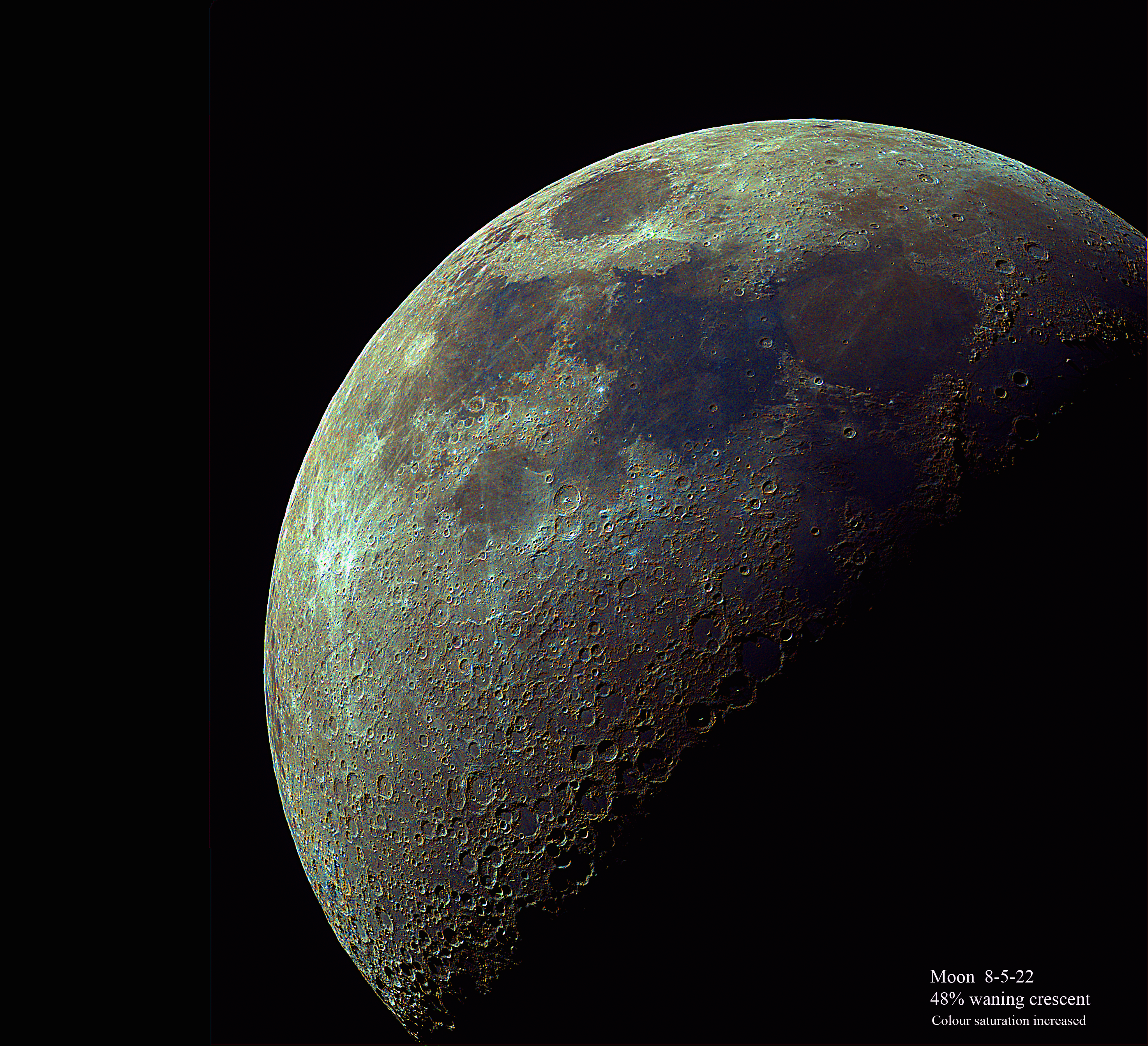
There’s no left or right, up or down in space so I’ll not apologise for the fact that this image of mine is flipped horizontally compared to the earlier one. The point of including it is to show that even the Moon has colour. We don’t see it because it’s muted and because it’s so bright overall that the colours are washed out – technically, it has a high albedo which simply means that it reflects a high percentage of the sunlight falling on it. However, in a digital image it’s possible to increase the colour saturation whilst holding back the brightness to show that the Moon’s surface geology does indeed imbue colour. As with all the planets, they appear as one colour or another by virtue of what’s on the outer surface. Thus Venus appears white because it’s totally covered with reflective clouds, whereas Mars has a reddish hue because there’s a lot of rust (oxidised iron compounds) on its surface; Uranus and Neptune appear blue-green and blue because of the hydrocarbon gasses which make up their respective atmospheres. (The Sun and other stars are different simply because they generate their own light; their varying colours from red to blue arise from their surface temperatures.)

There are several particularly bright areas which, if one looks closely, often seem to be associated with bright ‘rays’ extending from a crater or cluster of craters. It turns out that there is quite a lot of glass on the Moon’s surface – made when material was melted in a collision with, perhaps, a small asteroid – and it’s this material that reflects so much sunlight. Most domestic glass on Earth, like window glass for example, is made from a mixture of various chemicals with silica (sand!) but we can make a glassy material from all sorts of source materials if the heating and cooling rates are right. There are some terrestrial examples of this shown in the image above. The material shown on the left is a naturally-occurring glass called tektite and the yellowy material next to it is often referred to as ‘desert glass’; both are relatively pure samples of silica glass made when a meteorite plummeted into desert sand. The central image is of obsidian glass, which is formed in a volcano. The sample on the right is a glassy material which formed as a waste product in a commercial furnace dating to the Middle Ages.

We all know that shadows are longer when the Sun is low in the sky; the same holds true on the Moon, so the further away we are from a full Moon – when the Moon is face-on to the Sun – the easier it will be to pick out mountain ranges, valleys and craters. Speaking of mountains, this image of the Sun, taken alongside one of my grandsons during the partial solar eclipse which occurred on October 25th 2022, shows that the Moon has a slightly ‘crinkly’ edge because of its many mountains. (You’ll also be able to spot the sunspot clusters that were visible at the time.) I hope it goes without saying that these images are not to scale.


Wednesday, 14 September 2022

Professor Sir John Enderby FRS (1931-2021): a personal reflection


Shortly before I retired fully from my three decades as an academic at The University of Kent I wrote a short series of blog posts on aspects of my career (starting here). They were drafted in a bit of a hurry in response to a request from one of my colleagues – who was, it transpired, already contemplating a ‘retirement conference’ in my honour and wanted a little biographical material; they were far from exhaustive. Within that handful of posts there is mention of the person who kick-started my career in science in the mid-1970s and who influenced it from time to time for the next thirty five years or so …

When I first came across John Enderby he was ‘Professor Enderby’ and the head of the Department of Physics at the University of Leicester, where I was an undergraduate student. It was years later that he became a Fellow of the Royal Society and was subsequently knighted. Sadly, John died at the beginning of August in 2021; he was 90 years old. Only now, a year later and after the worst of the COVID-related restrictions and fears are in the past, was it practicable to hold a meeting to celebrate his considerable contributions to science. As one of the few people still around who had worked with him during his time at Leicester (and for whom the organisers had contact details) I was asked to contribute to the short talks planned for the first day of the celebratory meeting. It was an honour to accept the invitation. This blog post is, in essence, the distillate of my talk on September 5th at ‘Understanding the Structure of Liquids: Celebrating John Enderby’s Scientific Legacy’ at The University of Bristol.

Family members, friends and former colleagues as photographed at the end of the meeting’s first day by Adrian Barnes. (Should you wish to know, when this was taken I happened to be sitting third row back, second from the right; the image shown below is of the period I was speaking about in my talk.)

An immediate difficulty faced when putting together my slides arose from the lack of contemporary images: the key events took place well before the advent of digital photography or scanners. Photographs were something of a rarity, doubly so in the case of colour. Add to that the fact that I’d been ruthless in clearing out my office as I approached retirement ... I did however find a scanned copy of the above image, taken at a Research Council Graduate School held at Leicester in 1977. John is sitting front left and a very young me stands centre-rear. There are so many distinguished scientists of the time shown in this image, and quite a few early-career people who went on to build amazing careers of their own. (When I first located this image, I confess that one of my initial reactions was to lament the lack of diversity – a situation too often ignored at the time I regret to say.)

In truth, I can’t say I remember anything specific of John until the end of my second year as a naïve BSc Physics student*. I had requested a final year research project in the area of Solid State Physics – an area that had increasingly fascinated me during that year, probably due to some inspirational lecturers – but I honestly couldn’t recount my decision-making process now (even to myself). My project partner and I found ourselves tasked with the study of manganese chloride aqueous salt solutions using Electron Spin Resonance, a technique traditionally rooted within the realm of Chemistry. Could this really be a suitable project in Physics? Our project supervisor was to be none other than Professor Enderby, which was a scary prospect. (I discovered years later that the project’s inception owed much to a conversation that John had had with his research associate George Neilson, whose background was in Chemistry.) This was my first proper exposure to what would eventually shape my own research interests across four decades: the belief that so much of interest lies at the interface between our traditional subject disciplines. For that alone I owe John a huge debt of thanks.

Central to the images above is a monochrome image of the ESR spectrometer we used for our allocated final year research project. It was taken by the departmental technician who acted as official photographer. I was given a copy, as was my project partner, which I annotated by hand and included in my project report – the front cover of which is reproduced on the left. The report itself was typed using a fairly basic typewriter; the equations were inserted by hand as were all graphs, diagrams and tables. I generated a carbon copy for myself; there were no photocopiers in the department. Very few people possessed an electronic calculator at the time, which were still fairly primitive back then – and prohibitively expensive, so calculations were undertaken using logarithms and slide rules.

Unbelievably to us at the time, my project partner and I were invited to a party at John Enderby’s house to celebrate his research group’s success in winning their first truly substantial research grant from what was then the UK Science Research Council. Being made to feel welcome – a part of the team despite our particularly junior status – had a great impact; it afforded one of the many lessons I have sought never to forget. However, there were things to learn from the day-to-day as well. For instance, John’s habit of wandering through the labs. most days, coffee cup in hand, is one deceptively simple example. He’d engage anyone and everyone in conversation about what they were doing; keeping himself abreast of developments of course but, in the process, bolstering the confidence of undergraduate and early-career researchers alike … whilst also keeping them on their toes. With my time as an undergraduate student coming to a close I began the process of sorting out what my next step might be. I had obtained a place on a PGCE course, so secondary school teaching was one attractive option. However, despite enduring feelings of inadequacy, my ambitions were focused on the desire to dive into research. Thus, despite fascinating offers in the areas of ionospheric physics and geophysics, it took me relatively little time to accept John’s offer to join his group as a PhD student.

John’s own 1963 PhD thesis was entitled ‘Some electrical properties of liquid metals’ – my own, submitted sixteen years later wasn’t that dissimilar, although the theoretical landscape had altered considerably in the intervening period. The computational equipment available had progressed a great deal by the time my PhD project came to an end, but the project itself was conducted on a shoestring budget.

"Liquid metals" implies high temperatures – up to about 1750°C in my case – but without much of a budget everything had to be built by hand. Simple angle-iron frames held furnace bricks stacked within an asbestos box (- yes: I had to cut and drill such sheets, the work being done outdoors and using water to suppress dust; different times). The furnaces were lowered/raised using simple screw jacks and the basic vacuum system included copper tubing soldered together by me; I also did all the glass-blowing and the machining of many other components. The colour inset is one of my wife’s still life paintings: a jar like this was used as my primary calibration cell – the whole project rested upon its use!

As it turned out, after a period of study leave in the USA, John left Leicester for a post in Bristol only a year after my PhD began so I never did benefit from his continued day-to-day supervision. One of his Leicester colleagues, Alan Howe, bravely took me on and became my key early-career mentor in John’s stead. John and I stayed in touch however and met on innumerable occasions through the years. This included the period of his tenure as Physical Secretary and Vice-President for The Royal Society, during which time I recall being treated to an excellent meal at the Army & Navy Club so that he could debrief me on my department’s performance in the recent Research Assessment Exercise. I’ve lost count of the number of supportive references etc. he wrote for me, and I have cause to be particularly grateful for his gentle nudges into what became an extensive involvement with the UK Research Councils (see here).

During the first couple of years after the move to Bristol in 1976 John would visit his old department at Leicester often. On just such a visit he wandered into my small lab. for a chat. I wasn’t there, so he had to make do with my latest written log entries. At this point I ought to point out that John was incredibly enthusiastic when ostensibly exciting results emerged, but occasionally this enthusiasm misfired. In the longer term it was never a problem: as the saying goes, first attributed to Nobel Laureate Linus Pauling, “The best way to have a good idea is to have lots of ideas and throw away the bad ones.” John was a master of this approach, which I heartily applaud, but in the short term there are risks. He thought that my data on the resistivity of liquid palladium-silver alloys might represent the first evidence for ‘paramagnons’ in a liquid metal and he duly shared this idea widely. It didn’t, as I demonstrated through further measurement in the months that followed. No long-term harm was done; John was an excellent scientist: when I had generated more reliable data we simply moved on – that’s how science works.

The above are scanned copies of my PhD laboratory logbook pages, the graph on the left and the lower insert being the ones John saw during his unannounced flying visit. It would have been tempting to take this unexpected ‘spike’ in the graph at 33% Ag at face value. However, scientific scepticism – major claims need major evidence – and the desire for both explanation and reproducibility drove me to track down the origin of the feature. My ‘family tree’ of samples (central panel) showed that the ‘paramagnon-like’ feature was evidently associated with a single sample that had been contaminated by the tungsten electrodes I used. This sample, in its turn, contaminated subsequent samples made from it. Given my vanishingly small budget, I had to wait six months before I could buy fresh samples of high purity palladium and silver in order to measure this region of composition again. The graph on the right, although still fascinating in the context of the theories of the time, clearly shows that John’s paramagnons were, sadly, a will-o'-the-wisp.

There were rather few ways in which I could honour John’s scientific contributions, but in 2006 I nominated him for an honorary doctorate at my own university (Kent at Canterbury) which he was able to receive during a formal university degree ceremony. In 2014 I wrote a two-page article in the monthly magazine ‘Laboratory News’ in a short series on heroes of British science – it gave me my penultimate opportunity to pay tribute.

I hope I possess sufficient wisdom to choose to learn from others: to learn what works and what ought to be avoided. I learnt a great deal from John. Indeed, from my days as an undergraduate student, through various transitory research posts and to my thirty years as an academic with my own thoroughly interdisciplinary research team, John remained a person to learn from. I am thankful for the privilege of having known him.


* I had applied for a Joint Honours degree in Physics & Chemistry, but due to an ‘administrative oversight’ I arrived at Leicester to find myself registered for their BSc Physics programme. Lacking the self-confidence to anything other, I simply ‘went with the flow’. I have used the term serendipity often in relation to my career: this apparently random event is perhaps an early example.

Wednesday, 20 July 2022

A plate from the past: SGT and me


I follow many scientists and science-centred organisations on Twitter. In fact, they dominate the list of accounts I follow – which is hardly surprising given my interests. One of these is the Institute of Materials, Minerals & Mining and the other, which is closer to home in terms of my own scientific career in materials research, is the Society of Glass Technology They recently surprised me …

The COVID-delayed sixteenth conference on the Physics of Non-Crystalline Materials was held at the university I worked at before retiring more than seven years ago (see here for details of the current incarnation of my old department). I put something up on Twitter about how strange it felt to have a meeting running for week at my old stomping ground given that, a decade ago, I would have expected to participate. The SGT account holder, who I’ve known for a long time, replied saying that I ought to pop in to say hello as they had something to give me from several years back. How could I resist …

It turned out that they had commissioned a commemorative plate to mark the fact that I delivered the 2015 Mellor Memorial Lecture – the SGT and IoM3 share the hosting of this memorial lecture, and it was the turn of the SGT that year as part of its annual meeting, ‘Glass Reflections’ (here, this is an old link – pre-https days – so your browser may warn you that it’s not secure). I was honoured to be asked. Although I tried hard to prepare properly, I confess that I wasn’t pleased with my performance at the time; I’m almost never pleased with my performance. I was a little taken aback to have all this effort made to honour the event – and completely delighted.
David Moore presenting me with the plate (image taken by Christine Brown). The plate's inscription reads: Presented to Prof Bob Newport by the Ceramics Society - IoM3; 55th Mellor Memorial Lecture 'Glass: out of History and Art and into Tissue Regeneration'; 8th September 2015. The backdrop is a 2018 painting by Heather Gulliver showing an African Coral Tree; it hangs in the PNCS16 conference venue at the University of Kent.

Here’s a little background for you, taken in part from the IoM3’s web site: Joseph Mellor FRS (1869-1938) was a pioneering ceramist and heavily involved in the work of the Ceramic Society (which became the IoM3). He wrote several books including ‘Modern Inorganic Chemistry’. He was elected fellow of the Royal Society in 1927 – no mean feat.

In 2016, in their centenary year, the SGT elected me a Fellow of the Society – an honour I continue to treasure, but have only a certificate in commemoration (see here, second half). That will do nicely.


♪ The Sun has got its spots on … ♫


It has been a whole year since I last posted. I’m sure that this is in part one of many diverse legacies of SARS-COV2, but it’s also related to the fact that my primary focus for the blog was always to reflect on living life as a scientist.* I have in the meantime continued to write about topics in science elsewhere: using my u3a local branch’s social media group example. However, the point is that I intended only to write on this blog as and when my week involved me in rolling up my metaphorical scientists’ sleeves and getting directly involved. You can perhaps see where this is headed …

Last week I visited Year 5 of The Churchill School; one of the two classes is taught by my talented daughter-in-law, and it was she who invited me. I’ve been to the school many times before, but less often as a visiting scientist (e.g. here). I freely confess that school classrooms unnerve me. I (mostly) loved school when I was part of the whole thing as a child and I have the deepest of respect for excellent teachers like my daughter-in-law. However, nowadays, the thought of standing in front of a class of children – let alone two 30+ classes combined – with the aim of leading them into some new knowledge and understanding renders me a little weak at the knees. It was truly lovely, then, to get a warm welcome by the four staff members involved – but it was the eagerness of the 9/10 year-olds that completely blew me away.

I turned up while they were still in a school assembly so that I could get everything set up in peace. I had brought with me my newly acquired second-hand 72 mm refractor, the lightest of my two equatorial mounts and a tray of bits and pieces which included a homemade solar filter. The neutral filter material, which removes 99.999% of the incident light, is of the highest standard, but I can’t say the same thing about the cardboard and duct tape assembly that holds it in place in front of the telescope’s objective lens. In order for the equatorial mount’s tiny battery-driven motors to keep the telescope pointing towards the Sun over time, it has to be tilted to the correct latitude, levelled and compass-aligned. The telescope itself also needs to be balanced (both front to back and side to side). Once the Sun had been located and its image focused I have to say that I was more than relieved to see several sunspot clusters clearly visible; passing clouds were, as ever, less predictable. (By the way, the images taken at the school were carefully checked by them before they were released for my use; faces have been covered/blurred as necessary.)
I was given a generous introduction inside the school before we all trooped out to the school’s expansive playing field and the children sat in a semi-circle on the summer-dry grass. I kept my own introduction to the telescope very simple; no-one needed to know about focal lengths and lenses in order to observe the Sun. What did need to be shared at the outset though was the standard but ever-vital warning not to look directly at the Sun for fear of damaging the eyes. In this instance it was important to go much further, making the point that looking at the Sun through binoculars or a telescope is likely to cause blindness without the appropriate safety measures in place. You also have now been warned 😉
I had given them a rough idea where the sunspot clusters were by describing the Sun’s disk as a clock face: two and eight o’clock got them to the most obvious, although it was a busy day on the Sun and there was a lot to choose from. This is an image captured by a talented amateur astronomer, Roger Hyman ( find him here or here) on that same day; the image is used with his permission. The orientation isn’t exactly as we saw it – the angle of the camera he was using and other factors will affect that, but it’s close enough. All clusters of sunspots are given a unique identifying number and on Friday 15th July 2022 they were, beginning at the 2:30 position and moving clockwise: 3057, 3056, 3055 and 3053 (see here).
In between the slowly drifting clouds, everyone got a chance to look through the telescope – even the adults. All but a handful said they’d seen the sunspots: some after a bit of coaching in terms of how to use an eyepiece. It took a while, and given the need for a lot of patience they did astonishingly well.

Every time a cloud came over we used it as an opportunity for questions, which came thick and fast. Indeed, the flow of questions continued when everyone had had the opportunity to take a peek and we had moved back inside the building. These were exceptionally wide-ranging, and varied from the scientifically and philosophically challenging to the more speculative ‘what if’ (the Sun disappeared, you went into a black hole, …) and ‘would you’ (like to go into space, live on Mars, …) type of question. All of them deserved to be taken seriously and given the best response I could muster. I can only say that I was genuinely impressed; it was uplifting to see so much evidence of the potential on display within that classroom. A few of them were obviously highly clued up, and several made a point of telling me that they wanted to be a scientist. Perhaps what I should have said in response, but for some reason didn’t, is that in a sense they already were – just as much as I was at their age.

I was at the school for almost 2½ hours in total, although it felt far briefer than that.

I promised this blog post in order to provide a reminder of what we did, and to offer a little information in a more coherent way than I fear I managed on the day. Perhaps one might start by saying that sunspots are associated with a localised increase in the Sun’s magnetic field. They appear darker than their surroundings simply because they are a little cooler, with their central region (the umbra) at about 3000-4000ºC compared to the average of 6000ºC. Their sizes vary a great deal, with the largest being several times the diameter of the Earth. (If you are able to see the above image of the Sun on a reasonably large screen then you might notice the small blue dot I inserted to the left hand side: that is approximately the size of the Earth on the same scale.) Sunspots can last for days, but eventually disappear. The number of sunspots visible at any one time varies over the eleven years of the solar activity cycle; we’ll be at the next maximum in this cycle in 2024. You can find lots more information here, here and here; a recent BBC ‘Sky at Night’ programme covered some of this ground also.

Perhaps a fitting way to close this post would be to offer a couple of suggestions for useful astronomy apps and to share a small number of my own images. The first app I downloaded when picking up after retiring the hobby of my youth (from Android Play Store) was ‘Sky Map’, which I still use as a simple interactive guide to the sky; for a little more sophistication one might go for ‘Stellarium’. The choice is yours. In addition, and especially if you want to pursue this further, I’d recommend joining your nearest amateur astronomy group. Unfortunately, the one I’m in – Ashford Amateur Astronomy Society – is an hour’s drive from my home; maybe there’s one closer to where you live.

The above were taken at different dates, through different telescopes and with different cameras. The result is that we have a fairly recent image of the whole disc of the Sun together with a more highly magnified image of one part of the solar disc, and a close-up of two particular sunspot clusters taken in 2021 which bring out a bit more detail in terms of their structure. You’ll notice that each sunspot comprises a dark central region (the umbra) and a somewhat bright outer region (the penumbra); as you might anticipate, the penumbra has a temperature which is intermediate between the umbra’s and the Sun’s average surface temperature.

Happy observing.


* I retired from my paid employment as an academic and multidisciplinary materials research team leader about seven years ago, but I’m still a scientist – just as I was as far back into childhood as I can remember; I’ve covered this ground in earlier posts (e.g. here).


Thursday, 22 July 2021

Pictures of home


Our home, Earth, is a rare and peculiarly beautiful planet: a bright sphere effortlessly pirouetting through the black. In reality, it’s constrained within a routine choreographed by gravity and conducted by its home star, the Sun. Moreover, it doesn’t dance through space-time alone but with a partner in the form of the Moon – the relationship between them as unusual as the planet itself. Even the Sun is unusual within its peers. Our home planet is at one and the same time just like all the other countless planets in orbit around trillions of stars and yet, as far as we know, so unusual that we might even be tempted to call it unique. The mere fact of our presence on its surface, beings able to ask the searching questions we do, marks it out as special.

I have written about the Earth before (here), and during lockdown I recorded a talk on the subject (find it here). I’ve no intention of revisiting this material in detail – there would be no point – but I am going to celebrate the Earth in another way by sharing with you some of the images captured during my lifetime that have had a particular impact on me in one way or another. (I note in passing that the entirety of humankind’s rocket-based space exploration endeavours thus far have occurred during my life.) Given the thousands of beautiful, informative and sometimes shocking pictures taken from orbit – through the windows and lenses on the International Space Station for example – one might become a little blasé, or perhaps overwhelmed, by the choice on offer. Fear not, I am side-stepping them all; rather than study these ‘close-ups’ I want to share with you my enjoyment of the long-shots: the images captured from afar which reveal the whole Earth in its role as a rocky, water-rich ‘Goldilocks’ planet within our solar system. I might allow the Moon a look-in as well …

Although not the first picture of our home chronologically speaking, my all-time favourite image is arguably one of the poorest in terms of photographic quality: the so-called ‘Pale Blue Dot’ captured by Voyager 1. It was taken just before its cameras were turned off to conserve power as it headed towards the very farthest reaches of the Sun’s dominance and thence into interstellar space. Voyagers 1 and 2 were launched separately during the summer of 1977 (see here for more information; I was in my mid-twenties at the time!). Both were designed and built to provide the first close-up look at Jupiter and Saturn; Voyager 2 would in addition fly on to Neptune and Uranus, the outermost planets in the Solar System. The mission was to last five years … it’s still in progress four decades later, adding new science to an already astonishing portfolio. That fact alone sets the Voyagers apart in my imagination, but there’s so much more: to have designed a mission of such complexity on what was, relatively speaking, a modest budget and with the very basic electronic computers available at the time remains a triumph of scientific and technological endeavour. I still keep in touch with the mission’s progress via the Voyager Twitter feed.
On February 14th 1990, Voyager 1 was instructed to turn its camera and photograph the planets of our solar system whilst it was still just about possible. It was by then six billion kilometres from Earth. At this distance Earth appeared so small and so close to the position of the Sun that it was barely possible to capture anything at all. As it was, Earth represents only about 1/8th of a pixel and sits within optical artefacts – the streaks of light – caused by the much brighter sunlight entering the camera via its colour filters. The Sun itself is just out of shot. Venus was similarly difficult to capture; neither Mercury nor Mars could be imaged at all because of their positions with respect to the Sun. (I've added arrows to help you see the tiny bright dot that is Earth.)

‘The Pale Blue Dot’, in spite of its limitations, easily remains at the top of my list of the all-time-great pictures of our home planet. However, an image captured much earlier in the mission (far left) hovers somewhere nearby in terms of its ability to captivate my mind, my imagination. Only a couple of weeks after its launch, Voyager 1 took this picture of the crescent Earth and Moon from a distance of 11.7 million kilometres, and in the process illustrated the mission’s later potential. This was the very first time that the Earth and Moon had been captured in a single image (- the Moon is upper left; it's relatively dull compared to the bright Earth). Many analogous pictures have emerged over the years, each special in their own way. In the centre is a 2017 greyscale picture captured by the ORIRIS-Rex probe on its way to rendezvous with an asteroid. (Because the Earth is so much brighter than the Moon, the image has been processed such that the Moon’s brightness is enhanced by a factor of three.) In 2010 the Messenger probe, sent to study the solar system’s innermost planet, Mercury, looked back out and away from the Sun to capture the view of the Earth⸱⸱⸱Moon duo shown on the right. When viewed from the vicinity of Mercury, both the Earth and the Moon will always appear as bright full discs – no elegant crescents from this perspective. There are so many other broadly similar Earth⸱⸱⸱Moon shots of this type available online; I’ve pruned my selection heavily for this blog and in the process cut superb images such as those shown here and here.


If the ‘Pale Blue Dot’ tops my personal list of iconic pictures of home, then a very close-run second place must go to one of the staggeringly beautiful images captured by the Cassini probe during its extended sojourn at Saturn. This one (top) was taken in 2013 with Saturn backlit – in other words we’re looking at its night-time face with sunlight scattering through the ring system and outer atmosphere. A lower right segment of the wide-angle full image, shown lower left, reveals the Earth peeping out from behind the rings (there’s an arrow to help you locate it; Earth is about 1.4 billion kilometres away and at that distance each pixel of Cassini’s camera covers almost 9000 km of the Earth’s surface). Enlarged further in the lower right panel, we can easily discern the Earth⸱⸱⸱Moon duo. For sheer majestic beauty it would be hard to beat such a picture of home. In passing, note the apparent absence of stars in these pictures. The reason for this is simply that they are too faint to show up in an image focused on such a bright target.

Moving a little closer to Earth again, I’ll share with you a picture of home that also captivated me: an image taken from the surface of Mars by the Curiosity rover in 2014 (here). It’s nothing special in terms of photographic quality, but it’s reminiscent of the sort of photo one could take of Venus, say, from here: from the surface of one planet, a bright point of light in the evening sky which turns out to be a neighbouring planet. Almost homely. The central panel shows a reprocessed version of the picture with an enlarged inset of the Earth⸱⸱⸱Moon system. Taken at these sorts of distances we can be sure that the relative sizes of the Earth and its moon are about right; although even here one needs to consider the fact that the Moon and the Earth orbit each other such that their separation in space as viewed through a camera lens may appear to change. (Technically, they both rotate about their Barycentre – their centre-of-mass; see my blog post or YouTube video on the Earth for an explanation.) For pictures captured closer to home, like those shown in the Voyager/Osiris/Messenger images above, one needs to be even more careful since the apparent relative diameters may be heavily influenced by their respective distance from the camera. On the right hand side above I have inserted an image I captured on my smartphone of the crescent Moon and crescent Venus: Venus is, in reality, far larger than the Moon – but it is of course much further away from my phone than is the Moon, even if it does appear in the same part of the night sky above my garden.

An interesting thought poses itself in the context of these images of Earth from the Martian surface: how would one observe Earth through a telescope in the way we might observe Mars? The same considerations pertain for Earth observation from the lunar surface. One would be unable to look directly through a telescope eyepiece of course since there would be a spacesuit visor in the way. For a more considered exploration of this ‘thought experiment’ I recommend an article in the ‘Sky at Night’ magazine, here.

I have followed the development of space exploration from about the age of six – I remember Sputnik and Telstar, the first animals to travel to space (and die there) and the start of crewed missions – and was in my mid-teens when the first astronauts left their footprints on the Moon. Although the video images beamed back to our monochrome and distinctly low-resolution TV screens were epoch-defining, they were nothing to write home about in terms of image quality. However, the images taken by crew members …
The Apollo 8 mission involved using the Earth’s and the Moon’s gravitational field in order to do a loop around the Moon before coasting back to Earth; the crew practiced most of the manoeuvres necessary for a Moon landing without that final all-important stage. In the process, they captured a series of pictures which have become truly memorable. Later missions, through to Apollo 17, added to this collection and/or improved picture quality. Two of the more iconic pictures of home are shown above: ‘Earthrise’ and ‘The Blue Marble’. The latter is fairly self-explanatory, although it’s worth pointing out that the inclusion of a view of Antarctica was a novelty at this stage of the game. ‘Earthrise’ does need some discussion though. The fact of the matter is that Earth never actually rises: the Moon is tidally locked to the Earth, meaning that the same lunar face is always pointing toward us – how could we talk of the far side of the Moon otherwise. So, if one face is permanently facing Earth then it follows that the Earth is always visible above the horizon from half the lunar surface and always invisible from the other half: there is neither rising nor setting. (Just to amuse yourself, take a look at this gif which shows the Moon ‘photo-bombing’ Earth – what we can see here is the far side of the lunar surface, the side we can never see directly from our planet.) However, as the Apollo crew were orbiting the Moon it would appear from their perspective that the Earth rose and set each time they went around. The image on the far right is the actual orientation as seen from the orbiting command module; only by rotating the picture was it possible to present to us the final evocative picture of home as seen on the left. Unsurprisingly, ‘Earthrise’ became a poster-shot for the growing environmental movement of the day.

I might have stopped at this point had the chair of the Ashford Astronomy Association*, Jason, not reminded me of another series of spine-tinglingly good shots of our home world taken by Apollo mission crew. There exists some excellent video footage of the astronauts’ ascent from the lunar surface to re-join the orbiting command module (see here for example), but some of the stills are truly astonishing. The image above is one such: Moon in the foreground and Earth, home, shown in the distance.

I hope you have enjoyed my little gallery of pictures of home; feel free to share your own.


* I joined this lovely club a few months before ‘lockdown’; we’ve been meeting via Zoom ever since. I’ve had lots of good advice from its more experienced members which has probably saved me countless hours of trial and error when trying my hand at astrophotography, and some pretty decent suggestions for beautiful things to observe.