Showing posts with label Heritage. Show all posts

Saturday, 14 October 2023

House of (more) Treasures


In a recent post (here) I waxed lyrical on the subject of my first visit to the Canterbury Cathedral Library and Archives: “[sitting] at a desk surrounded by old wood with light filtering in through handmade glass, and to hear at one point the cathedral’s bells drifting through high ceilings”. I have now embarked on a six-session u3a course in the history of printing in Europe, led by Dr David Shaw, so get to spend even more time there. Such a joy.

The course itself, which is proving to be a delight, has thrown up several nuggets of information to be nestled in the memory, awaiting their time. For instance, did you know that the terms ‘lower case’ and ‘upper case’ derive from the days when a compositor – the person who set each letter of a font in place in order that a page might be printed using a manual printing press – had to select the next letter in a given word: their font cases were arranged such that the more common letters, ‘e’ for example, were close at hand (literally in the lower of the usual arrangement of two font cases) and those less commonly required, capital ‘Z’ perhaps, were in the more distant or upper case. When working with the speed allowed by ‘muscle memory’ this could save a lot of time and effort, rather like touch-typing – a skill I have, regrettably, never properly acquired. It’s no wonder the apprenticeship lasted seven years. This would often be followed by a period as a ‘journeyman’ during which the person would travel to various printing works in order to expand their experience and expertise. The size of a font was also defined at this stage, with 72-point corresponding to one inch (1″) – thus, a 12pt font corresponds to letter/number heights that fit within 1/6th of an inch or a little over 4 mm. This was, evidently, an early example of industrial standardisation; paper sizes were similarly standardised.

However, my principal focus in this post is to mention one of the books that David thoughtfully made available for us to marvel at during our mid-session break: Robert Boyle’s 1660 work on what we would now think of as air pressure and the like. Robert Boyle was a founding member of the Royal Society and made seminal contributions to the physical sciences; indeed, the slightly younger (but perhaps nowadays more famous) Isaac Newton used some of Robert Boyle’s work in order to derive an equation for the speed of sound in air. It is a personal pleasure to be able to turn the pages of this beautiful book; moreover, in a straw poll of the twelve other u3a members with me on this course, I discovered several people had retained a memory of hearing about ‘Boyle’s Law’ from their school days – a testament to his legacy.

Having discovered – whilst drafting the earlier blog post referred to above – the extent of the time and energy required of the Cathedral’s hard-pressed Archive & Library staff to generate and supply images of old documents in their collection, I was delighted to find online a ready-made image of another copy of the this very book. The above title page and example illustration comes courtesy of the Science History Institute and is made available under Creative Commons Public Domain Mark 1.0 Universal.

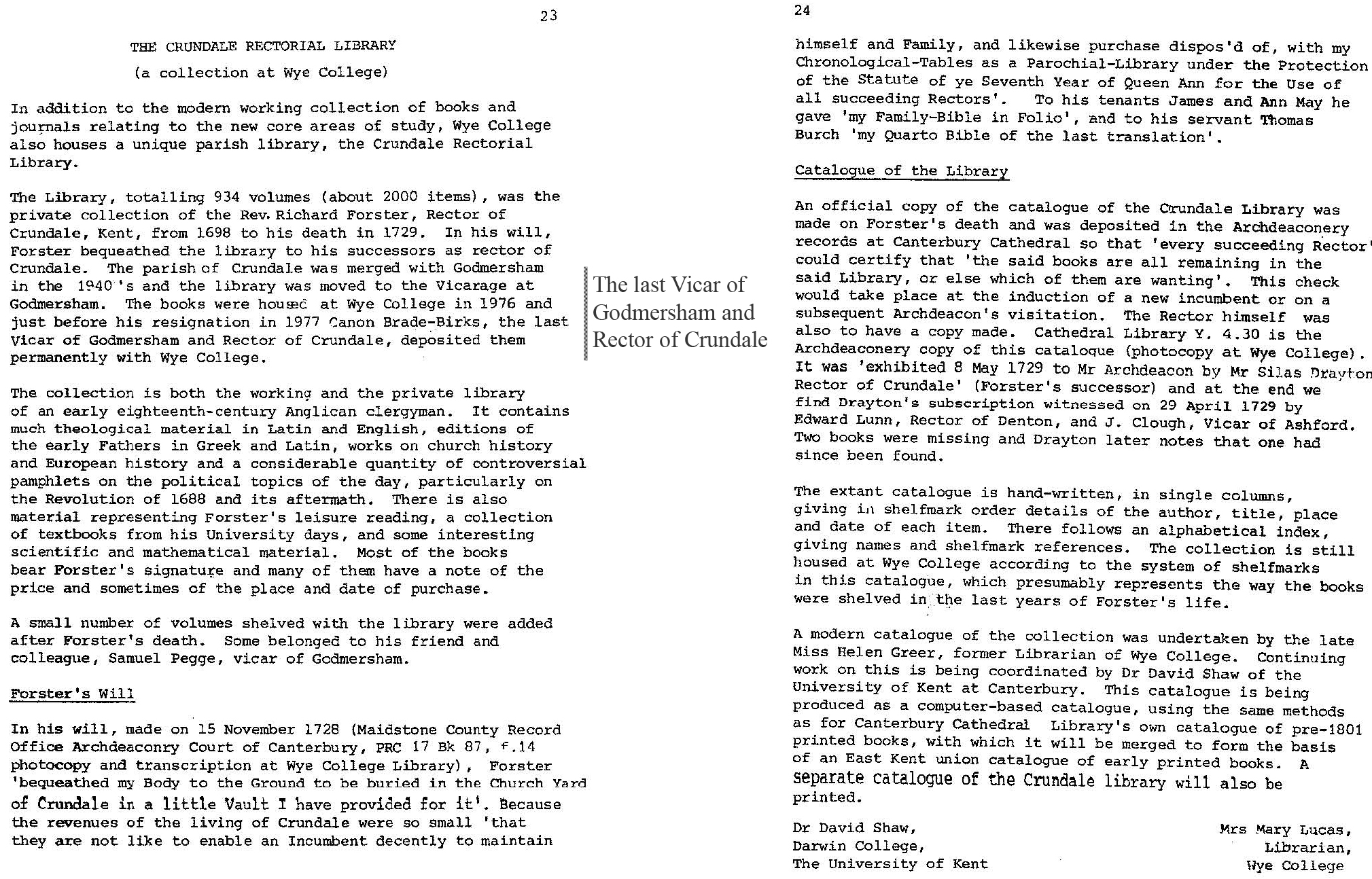
Not only was it fascinating simply to see and touch this original copy of Robert Boyle’s ground-breaking work, but I learnt from David that there was a (tenuous) personal connection to the story of how this rare book came to be in the Cathedral’s collections. As may be seen in the document reproduced below, the book was a part of the collection of a former Rector of a parish not far from where I live. The Rev. Richard Forster was born only seven years after Robert Boyle’s death; he amassed an impressive library containing many hundred books and much else beside. As one might expect, works on theology were prominent but alongside those were mathematical and scientific books. In his will he left the library to his successors in the role. At some point the task of being Rector of Crundale was combined with that of being Vicar of the nearby parish of Godmersham and the library was transferred to the beautiful vicarage at Godmersham.
Reproduced from a document on David's website (here).

The vicarage was situated just outside the boundary wall of Godmersham Park which, as her fans will know, has a close connection with the writer Jane Austin. It also commanded enviable views across the River Stour and as a result of this proximity and its age, suffered from damp at ground level; its library was accessed via an impressive spiral staircase. My parents-in-law lived in the Godmersham parish; indeed, my father-in-law served as churchwarden for fifty years. Moreover, my wife and I were married in Godmersham church in the late 1970s. The wedding was conducted by the then Vicar/Rector, Canon Graham Brade-Birks – who has been mentioned with affection in a previous post on this blog site, here. I’m pretty sure that he was already eligible for retirement when he conducted our wedding service but he was a man with the clear conviction of his calling, and retirement was postponed for as long as was practicable. However, after he eventually retired, the vicarage was sold (to ‘someone in television’ as I recall) in order to raise funds for the Church of England and there followed an extended interregnum: there was, therefore, no successor to whom the library’s contents could be passed. Thus, although non-stipendiary (unpaid, usually part-time) vicars/rectors were subsequently appointed, Canon Brade-Birks was indeed, in effect, the last of the line. Hoping to ensure the survival of the library’s contents, he left it to the nearby Wye Agricultural College where he had taught the odd course on soil science. (I have also written a post mentioning Wye College, where I was employed for a year after leaving school – see here). At the time, the College was a constituent part of the University of London. It was later subsumed into Imperial College and then closed and sold off; the collection that had been looked after by Canon Brade-Birks was eventually handed into the care of Canterbury Cathedral’s Archive & Library.

As I admitted, this is a tenuous link. For such links I am, however, grateful.


 (I acknowledge with thanks the editorial suggestions offered by David Shaw.)


Saturday, 11 March 2023

Lost, and found again: the Graveney boat and me.


By my reckoning, I was seventeen. Reverse the digits and you’ll arrive at my age on my next birthday. I was, in a great many respects, another person; a person who so easily might have chosen, or have stumbled through a doorway other than the one I actually took, ending up who-knows-where.

A model of the clinker-built late ninth century ‘Graveney Boat’ displayed within the Fleur de Lis museum in Faversham – almost on my doorstep, but only visited recently in the company of my teenage grandsons (who are ‘collecting’ the fifty or so small independent museums in our region … as one does.) When I saw this tiny model in its display case I couldn’t help but smile; read on to find out why.


I’ve mentioned serendipity – perhaps that ought to be providence – many times in my posts (e.g. in the first post of a short series reflecting on my career as a scientist, here) but a recent visit to the Fleur de Lis museum in Faversham provided a rather joyful reminder of its potential. Back in the day, I used to volunteer my weekends as a helper on local archaeological excavations. We’d be picked up early in the morning and driven to wherever there was a need for ‘emergency archaeology’, by which I mean the desire to uncover artefacts and learn as much as one could in the limited time before a developer’s bulldozers moved in. Some years would elapse before such sites/finds were afforded protection under law (see here and here) so it really did feel like a valuable and an exciting thing to do. Also, I was a seventeen year old with zero interest in sports – chronic asthma at a time when treatments were limited, two left feet and distinctly bookish tendencies coupled with a well-developed inferiority complex – but with the usual innate need to be doing ‘something’. Volunteering in this way fitted the bill perfectly: an inexhaustible excuse for reading, small groups of like-minded people and working outdoors in out-of-the-way locations. As a bonus, my dad was a bricklayer and so the instruction to bring your own pointing trowel was easy to follow. What’s not to love?

Pursuing archaeology as a career appealed to me a great deal. At this distance from the person I was back then I cannot begin reliably to reconstruct the thought processes that steered me towards studying physics and then beginning chemical physics research. The existence of radiocarbon dating techniques and the later introduction of geophysical probes like resistivity and magnetometry would only serve to heighten my interest, but by then archaeology had become an armchair hobby overshadowed by my fascination with the physical sciences. (The line became blurred a little during the final years of my professional career when I was able to use my chemical physics expertise to make a small contribution to heritage/conservation projects: see here, here and here.)

I only volunteered for one season in 1970 (maybe a little in 1969? – other priorities, like final school exams and university applications, squeezed it out thereafter) but the joy of taking part has stayed with me ever since. Having said that, you may be surprised when I admit that, somewhere along the line, I forgot the associated details. I could always have told you that our mentor in this voluntary work was enthusiastic archaeologist Mr. Jim Bradshaw (who died in 2001); he was a good person to learn from as I recall. I also remember that the two multi-weekend digs I took part in during this period were poles apart in their nature: well-drained flat farmland abutting an oil depot which was hiding a Romano-British residential/industrial site, and mud-up-to-the-armpits marshland which revealed a ninth century boat. In one case, the land would return to being farmed and the other was in the way of a major drainage channel.

The Romano-British site (see the 1990 aerial image below, with links) had apparently been known about for several decades, with bits of pottery being turned up by the plough now and again. More excavations were conducted nearby in the decades following my involvement and within a much better framework of legal protection than the one I was a part of. (These later digs were as a prelude to the deserted oil depot’s removal in favour of housing.) I remember exposing a hearth – a flat patch of hard reddened soil in essence – and being shown how to distinguish ‘random’ chunks of flint, found in abundance in the region, from the remains of an ancient drystone wall or a well-constructed path. However, the highlight was exposing a small but whole clay jar. I had Mr. Bradshaw and a few others clustered around me as I was talked through the safe way to excavate and lift it. The best guess at the time was that it had once contained perfume.

This aerial image of the location of the Wye Romano-British site was taken in 1990, before later development and the excavations that preceded it. Further information may be found in reports submitted by Mr. Bradshaw and by those making reference to his work: here from 1970 in Section II, here from 2016 from 2016 and here in paragraph 2.2 from a national archive.

As you’ll no doubt recall, what prompted this post in the first place, and the online research undertaken in order to write it, was the happy accident of finding mention of ‘The Graveney Boat’ during my extended exploration of Faversham’s Fleur de Lis museum. (The Graveney Marshes, I ought to explain, are sited between Faversham and the North Kent coast (UK); there is also a village of Graveney.) None of the images I could find do justice to the mud; nor do they convey the camaraderie that coping with it engendered. However, I’ve included one below along with a slew of links to associated news items and formal reports; this was, without doubt, a big deal. Whilst at the museum I had a brief conversation with someone working there during which I asked about the fate of the boat. She informed me that The National Maritime Museum, who had taken overall charge of the project and had all the recovered material sent to them at the time, still retained the excavated timbers. Apparently, it’s still being stored under water as there are no funds to conserve it further – let alone to repatriate it to the nearby Faversham museum. Having been involved in a small way with the conservation of Henry VIII’s famous warship ‘The Mary Rose’ (here) I must admit that I felt very sad that funds didn’t exist to allow the excellent marine conservation resources in Portsmouth to be brought into play. C’est la vie, I suppose.

The images above are both taken from a 1971 paper in a publication called ‘Antiquity’; there’s another paper, less easy to access, published the following year in ‘Studies in Conservation’. Perhaps the feel of the place and the excavation work required is better conveyed in this (pre-HD) video, available via the Fleur de Lis museum’s web site.

All-in-all, I’ve had a pleasant trip down Memory Lane and had great fun piecing back together again the details of my season in the field as a volunteer archaeologist – a career path never trodden.