Friday, 13 April 2018

That Which We Call A Scientist


When I first conceived this blog, more than fifty posts ago, I set myself a limited number of goals. In essence, my aim was to try to encapsulate a lifelong love for the sciences by reflecting on some of the things that I do and experiences I have had in its pursuit; thereby, or so I hoped, others might be drawn by my passions. There was a self-centred motivation as well: I enjoy the process of writing; it helps me sort out my thoughts and make a little more sense of who I am and what I am doing. Were I not writing for myself, at least in part, it is doubtful that the blog would have continued for very long.

Given that I am no longer paid as a full-time professional scientist, having ‘retired’ from my former post as Professor of Materials Physics a couple of years ago, my contact with ‘things scientific’ has changed. There is some reflection of this in the previous post, here. However, this new vantage point has brought something into focus that relates to my blog’s original objectives but which I haven’t considered in a direct fashion hitherto*. My posts have, by design, omitted swathes of day-to-day life – even when events within it had a direct impact on being a scientist. That phrase, ‘being a scientist’, is at the core of the blog’s raison d’être but the emphasis has never rested on the word ‘being’. Thus, in this particular post I have decided, albeit in a generic rather than an overtly personal sense, to offer a reflection on that which links ‘being a scientist’ into the warp and weft of humanity.

Where better to start than with the thoughts of a couple of William Shakespeare’s characters. The very title of this post is an adaptation of lines spoken by the young Juliet in his Romeo and Juliet:
“What’s in a name? That which we call a rose, by any other name would smell as sweet; so Romeo would, were he not Romeo called.”
More powerful, I think, are the haunting lines spoken by Shylock in The Merchant of Venice as he highlights a particular mindset within his society (- endemic religious prejudice against Jews in his case); I have edited in the title ‘scientist’:
“Hath not a scientist eyes? Hath not a scientist hands, organs, dimensions, senses, affections, passions? Fed with the same food, hurt with the same weapons, subject to the same diseases, healed by the same means, warmed and cooled by the same winter and summer …? If you prick us, do we not bleed? If you tickle us, do we not laugh? If you poison us, do we not die?”

The point of all this is to lay claim to the fact that a scientist isn’t particularly ‘special’ in a qualitative sense. Were I a sporting person, a bricklayer, a nurse, a priest or a farmer I might therefore also write an analogous post on this theme – but I’m none of those things: I happen to have enjoyed a career in science. Scientists are neither sub-human nor super-human. This might seem self-evident; it should be self-evident. However, I have met and/or witnessed enough examples of scientists being stereotyped towards one end or the other of an imagined spectrum to know that bias, unconscious or otherwise, is far from uncommon. In truth, bias is endemic. We all suffer from it in multiple ways: it’s important to realise that it’s present since awareness can be an important form of mitigation against its effects.

Thankfully, I’ve no personal experience of being labelled a genius, and my entire career has been enriched by the joy of never having worked solo, but both labels may become attached to scientists as a way of categorising them. There was a time, particularly during the later decades of the last century, when I felt nervous about admitting in a social setting that I was a physicist: the development of nuclear weaponry, and many evils besides, might be laid at my feet by the proverbial prosecution. My protestations of innocence weren’t always effective. A little easier to handle are the often diffuse exclamations that emerged from an ill-defined, even visceral, school-induced fear of science – and physics in particular. In such situations the conversation could convulse to a rapid end without prompt intervention. I often respond by admitting that science is pretty much the only thing I’m any good at, and it’s usually safe to add that I couldn’t do what they do – whatever that is – even if I had another lifetime in which to try. We are each valuable for who we are, not for what we do. (In passing, I can't help but quote a favourite line from the recently-released movie Isle of Dogs, spoken by a student to a character called Yoko Ono: "Pull yourself together, remember you're a scientist!)

So, Doctor Who or Doctor Strangelove: shall we adopt a caricature? We so easily slip into stereotypes, but Juliet and Shylock both offer a better approach. I value and enjoy my ‘life scientific’, I always have, but I’m neither an evil genius nor a hero. I have been ecstatic at new birth and felled by bereavement, I suffer the same sorts of physical and mental illnesses as others; I love, enjoy, dislike and hate; I succeed and I screw up; I have insight and I’m in a fog; I disbelieve and I have faith; … just like you.

Images: https://www.youtube.com/watch?v=ozg7gEchjuM and https://www.theguardian.com/tv-and-radio/2017/nov/09/doctor-whos-hardest-task-yet-making-yellow-braces-happen

________________________________________________________
* I recall, and with a smile on my face as I type, that during one incarnation of my research team (in the ‘90s as I recall) I was forbidden from using the word ‘hitherto’. I had evidently used it so frequently that it had become an annoyance. There’s no-one to stop me now ;-)
________________________________________________________
Postscript: There may be a sense in which this post and the one that preceded it by a week marks a point of change in this blog. Given the reduced rate at which ‘things scientific’ present themselves within my life, I wonder about allowing it to come to an end – or perhaps simply to rest it for a while. An alternative would be to allow the contents of any future posts to drift from my initial vision into new areas. We shall see; I have come to no conclusions. The default will be to ‘rest’ it and then to see whether anything new comes along or to mind that I feel compelled to write about. Of course, if the rest goes on for long enough it will become indistinguishable from closure …


Saturday, 31 March 2018

Tapering: towards an end, a beginning


It was about four years ago that I began to taper, flexibly. What has been surprising in certain respects is the nature and duration of the taper, with a corresponding joy emerging from the serendipity of the new. In this post I try to reflect upon the transition from full-time academic scientist into a ‘freelance’ scientist who is developing other interests, and the extent to which echoes from the former are still being enjoyed.

For very positive personal reasons, and after a cluster of re-alignments in research activity (e.g. here) and sensing a reduced scope for further innovations in teaching (e.g. here) I decided to become my university’s ‘guinea pig’ within a new scheme for ‘flexible retirement’. It worked well in terms of re-balancing my week and seemed a sensible initial step towards an eventual retirement in the more conventional sense of the term. Thus, for approximately 18 months I drew a fraction of my university salary and a complementary fraction of my pension. The eventual decision to retire from my post completely arose fairly organically from this interim stage. However, the final step brought with it at least one surprise – on the day of the retirement celebration planned by friends within my department. Catering had been organised, invitations sent out and I had begun to steel myself for the necessarily emotional aspects of the event. However, a police-issued order for a lock-down intervened: someone had called them with a (hoax) bomb threat. So no catering, and half my university friends/colleagues were locked in their own buildings; even my wife was stuck at a road block and unable to enter the campus. A kind soul remembered that there were some crisps (potato chips for those in the USA) and peanuts left over from a student reception the previous day, and the residual tea/coffee was augmented by the generous gift of a few bottles of wine which happened to be in the Head-of-Department’s office. I made a few impromptu remarks – my remarks tend to be impromptu – about how life is made of relationships, and that it would be the people I would miss the most: which I meant, and still do. Once the cordons were lifted, we all went our respective ways. I was retired.

Here, at the end of all things (Image adapted from https://imgur.com/gallery/OOTGg, with creative appreciation also to JRR Tolkien and to Peter Jackson. Feel free to interpret the image in light of my chosen title to whatever degree you believe is appropriate. For my part, ‘beginning’ is the title’s keyword: I simply wanted to be able to show an image that had about it a sense of ‘tapering’ from one state into another.)

In the two and a half years since that ‘interesting’ day I have accumulated abundant evidence of post-retirement opportunities – those utilising my disposition as a scientist as well as those in wholly new areas. I’ve reflected on this before, e.g. here, here and here. However, what was only partly anticipated at the time was the extent to which my former professional life as an academic teacher and researcher would roll forwards for as long as it has. The motivation for uploading this post derives from the fact that I seem to be approaching the point at which I can declare that I have indeed ‘cleared my desk’ in the metaphorical as well as the literal sense. Even my agreement, more than a year after retiring, to write the inaugural post for my Department’s new blog seemed to symbolise the extended process of tidying up. (Here, in its original form.)

One specific component to the pre-retirement discussions with my Head of Department involved an agreement to return for the Spring teaching term following my Autumn retirement date in order to teach a particular 24-lecture module. This would enable the Department more gradually to bring recently appointed early-career colleagues into play. I was content to do this; it was understood to be a one-off ad hoc arrangement with a specific and well-defined objective. Teaching undergraduate Physics students thereby ended completely a mere six months after I had retired. Defining an end to my former research endeavours is nowhere near as straightforward.

Setting aside the glorious-but-hard-to-cope-with day, about seven months after the date of my formal retirement, on which many colleagues and friends came together in generous celebration of my career (here) there have been references to write for former members of my research team as they move from success to success, and continuing to act as a sounding board for those colleagues I was privileged to mentor. I’ve also had a sprinkling of other ad hoc tasks associated with my career-long support for the UK’s major research facilities. Rather more extensive has been the effort to realise my hope to see any significant residual hard-won data analysed, interpreted and submitted for publication. This is not only of intrinsic professional importance to me and my former team members but there is, in my opinion, an ethical need to make sure that the publicly-funded research we undertook is properly peer-reviewed and openly published insofar as we are able to do so. The difficulty, and at the same time, the pleasure, of trying to move forward on this is that it depends crucially on those research scientists with whom I undertook the experiments in the first place. It has been a delight to have seen four post-retirement journal papers emerge thus far, and to know that the fifth – and probably final – manuscript was accepted for publication just a few hours before this very post was uploaded. Interestingly, this final paper is both the longest in terms of pages of text and the oldest in terms of the date at which the data was gathered. It relates to a hugely ambitious experiment a colleague (Jacqui Cole) and I conducted in the USA which yielded a complex set of data on rare earth glasses in need of a novel and bespoke approach to its analysis. It has taken us more than a decade to complete the task, even with invaluable input from a couple of talented early-career researchers. Out of the results of our work I will also be able to present a paper at the annual conference of the Society of Glass Technology in September (abstract here). Will the taper in post-retirement research activity conclude at that point? I’m working on the basis that it will, but I have learnt to hold such conclusions lightly. 
Heuristic diagram of the local atomic structure in a rare earth glass.
There is a postscript: ‘freelance research’ has yielded some unexpectedly sweet fruit. I have had the opportunity, since I retired, of contributing in a small way towards the conservation of the stained glass at Canterbury Cathedral (see here) and of contributing to the study of star-forming regions in our galaxy (see here). I presented the glass conservation issues at a conference eighteen months ago, and a manuscript derived from the ‘citizen-science’ observational astronomy project has recently been submitted for publication. Science goes on, as it surely must. I am delighted to be a part of that process even now, albeit in an increasingly novel guise as time passes. I am also pleased to be able to confirm that new outlets for creativity, outside of the conventional boundaries of ‘science’, have readily emerged in order to enrich life.

Young stars don’t collect additional matter from the surrounding disk at a uniform rate. A given star may have periods when its brightness increases quite significantly because the rate at which it is accreting new matter from the surrounding disk has increased markedly. There are theoretical models for all this, but a lack of data. This is where the citizen science project came in. (Image adapted from http://sciencewise.anu.edu.au/articles/accretion)


Friday, 23 March 2018

Pick a Scale


Back in time, when I was still a salaried academic, one of the students in the course on Matter I taught [1] managed to derive a novel form of creativity from my lectures. I habitually made audio recordings – later, video recordings – of my lectures available to students for revision purposes (and to help with dyslexia etc; see here and other related posts) but this one student found another use for them. He cut snippets from my lecture recordings and dubbed them onto a piece of music. I only found out about it after it had travelled, viral fashion, around the student body. I took it as a compliment, and still do. In order that you can enjoy this as well I've uploaded it to YouTube, here: it benefits from volume and decent bass [2]. One of several things I learnt from his creativity is that I had, and most probably still have catch-phrases. There was one, however, that almost certainly led the pack in the context of this lecture course: “pick a scale” and its close variants.

Why? Because the most common cause of needless mistakes within their numerical exercises was the admixture of measurement scales and a confusion regarding the units associated with a given scale. Thus, someone might mix grams with kilograms and be out by a factor of 1000 – make this mistake more than once in a calculation, or do so in the context of an equation in which the mass, for example, appears more than once, and the results will be thrown even wider off the mark. It was a problem that dogged the students in this programme more than most simply because they were often older than the usual direct-entry undergraduates and/or came from a wider range of educational backgrounds. Many of them had, like me, grown up with measurement scales and units that were commonly used before SI units, the système international d'unités, held sway as our metric framework.
A ‘useful’ plastic ruler from my past: upper scale showing centimetres and their metric sub-division into millimetres; lower scales showing inches and subdivisions into tenths, twelfths and sixteenths.
Within my own formal education I had begun with imperial units (miles, feet & inches; pounds, hundredweight and tons; hours; degrees Fahrenheit …) and all the derived units that went with them or alongside them – like foot-pounds to quantify energy and pounds per square inch as the unit of pressure. Many of us in the UK will still think in those terms on a day-to-day basis; many more in the USA will follow suit. I was versed in these things until my mid-teens; even the wicket on the cricket pitches my father and brother played on, and my son still does, are precisely one chain long (stumps to stumps; one chain = 22 yards = 66 feet). However, by then I was veering towards the sciences, and therefore also mathematics, and metrication became the thing – we were required to familiarise ourselves with the CGS system: centimetres, grams and seconds, and associated units like degrees centigrade. We were obliged to change yet again within two or three years. By then I was in the final stages of my secondary schooling – senior years of High School within the USA, approximately – and had opted to specialise solely in the physical sciences. (I specialised because that was what one did back then, and it remains the norm in England today unfortunately. By preference I would have added English Literature and either Archaeology, Logic/Philosophy to the mix.) This time it was a blessedly less radical move into the MKS system: metres, kilograms and seconds, and their associated units. The final change, or at least I hope and believe it’s the final one, came when I became an undergraduate Physics student: MKS moved almost effortlessly into the SI system, which retains the same base units of length, mass and time.
My wife still uses these imperial-scale scales in the kitchen, as do I when following classic old recipes – particularly for jam (or jelly for those in the USA). The mass currently on the scales is one pound (1 lb); the others shown are ½ lb, 4 ounces (4 oz, i.e. ¼ lb), 2 oz and 1oz.
Thus, I could empathise with my students because I had seen even larger shifts in the way we quantify our measurements of our world than they had. However, empathy alone was of little benefit to them – hence the need for many reminders to make sure all the numbers they were using were associated with the same measurement system, preferably SI: whence was born a catch-phrase …

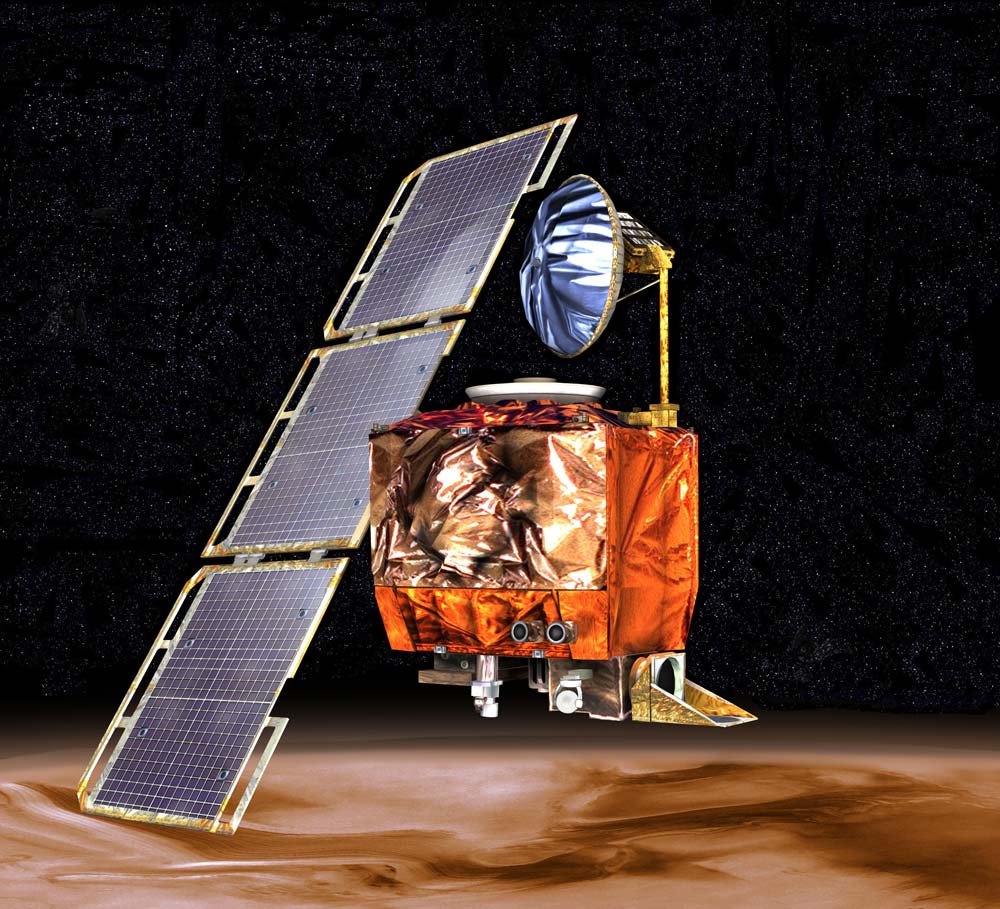
Lest anyone think this is an issue of minor irritation to a few early-years students, I’ll share with you the story of NASA’s $125M Mars Climate Orbiter from the late ‘90s. It burned up in the Martian atmosphere because engineers had failed to convert units from imperial to metric (see here). To bring it forward to today, just imagine the consequences of an analogous error in the software of a driverless vehicle. Scales and units are a non-trivial issue.
Mars Climate Orbiter 
Nothing in what I have said should be taken as a statement that the scales and units of former days were intrinsically inferior. I habitually use the metric system – almost always the SI – because it makes my life easier, both as a scientist and when in the kitchen or at my workbench, but these other scales have their strengths. Imperial scales are often quite intuitive for instance: a foot corresponds to just that – the average length of an adult foot, and an adult’s stride becomes a yard; the acre, a measure of area, was defined in terms of the farmland that might reasonably be ploughed in one day prior to mechanisation. The Fahrenheit scale, likewise, was established such that 0ºF corresponds to the lowest temperatures one might expect in Winter (- bearing in mind the parts of the globe in which the scale was being used) and 100ºF to the highest Summer temperatures to be expected. It’s all very sensible as far as it goes. Moreover, even now, and amongst a scientific community using SI units by default, there are ‘useful exceptions’. Astronomers and planetary scientists speak in terms of the astronomical unit, AU, for example, which is simply the average Sun-Earth distance; mass is often given in units of Earth’s mass or the Sun’s mass. Closer to home, although I perhaps ought to be employing the nanometre, nm, I still use a length called the Ångström when I’m discussing the separations between atoms: this was initially established as the diameter of a hydrogen atom – the smallest atom and therefore a useful ‘measuring stick’ in this realm. There are 10 Å in each nm.

For a useful compilation of scales and units, old and new, see here.

An obvious weakness in the historical scales, certainly as they were originally established, is that they could – and did – vary quite markedly from one community to another, much as the time of day varied within a country when all calibration derived from the Sun. Even after standardization was achieved there remained significant issues, not least with the English-speaking world. For instance, a gallon in the UK is not the same volume as a gallon in the USA: in fact it’s approximately 20% larger. However, these are well understood differences. More troublesome by far, to my mind at least, are those ad hoc scales/units invented ostensibly to help us understand something but which serve only to obfuscate and confuse. There is a depressingly long list of examples: measuring an area using a ‘football pitch’ as the unit, or a height in terms of Nelson’s Column in London, or a length in units of London buses, … My personal ‘favourite’, which I spotted in one of my grandsons’ books a few years ago, came from an author trying to convey the mass of one of the monoliths which make up Stonehenge by informing us that is was the same as 22 sheep! I can’t help but think that these inventions are counter-productive.


Footnotes
[1] I was teaching this within our Foundation Year programme which I helped to start back in the early ‘90s. The programme, inserted before the more conventional undergraduate degree programme, has offered a ‘second chance’ to hundreds of students in the succeeding years. I loved teaching within it, and the students I met whilst doing it.
It’s amusing to see that the lead text at the top of the current web page still has its roots in what I wrote for printed course booklets back then: this Physics evidently ages well.

[2] The music is Tractor Beam by Eat Static, which is used with their kind permission; the image is of Bulkhead by Rick Kirby and this stands outside the Marlowe Theatre, Canterbury, UK.

Image of Stonehenge adapted from http://www.english-heritage.org.uk/visit/places/stonehenge/ and the cartoon sheep are extracted from http://clipart-library.com/clipart/1686234.htm


Thursday, 24 August 2017

Now we are Twenty


The following post first appeared here - to mark the start of a new venture in blogging by my old department; it is included here by kind permission of their Marketing and Recruitment Officer, Katherine Moss. The format has been altered a little from the original, and minor changes to the wording have been made in order for it to 'make sense' within this blog.
___________________________________________________________________

Now we are Twenty

When I was one,

I had just begun.
When I was two,
I was nearly new.
When I was three,
I was hardly me.
When I was four,
I was not much more.
When I was five,
I was just alive.
But now …
(Taken from “Now we are Six”: a collection of children’s poems written by A.A. Milne and first published in 1927.)

The School of Physical Sciences, SPS, came into the world twenty years ago on the 1st of this month (i.e. 1st August, 1997). It was a difficult birth. The good news, however, is that the commitment, experience, wisdom and innovative expertise lavished upon it by its many supporters have paid off: they have brought the School to a position of maturity and strength. To mark this anniversary, and to give SPS the platform to celebrate future events, a departmental blog is being launched. The following ‘snapshot’ of the School’s back-story and its early years serves to kick things off.

By the mid-1990s the nation-wide decline in qualified people wanting to study either Physics or Chemistry was biting the university sector hard. Physics, and to a lesser extent Chemistry departments were closing down as their respective university management teams sought to cut costs. In the end, it was only a minority of universities that could boast a Physics department; Chemistry faired a little better, but suffered nevertheless. Against that background, it is a testament to the University of Kent that it managed, albeit with difficulty, to hang on to both its Chemical Laboratory and its Physics Laboratory, although they were financially squeezed. (‘Laboratory’ and not ‘Department’ you’ll note: a reflection of the University’s foundational belief in moving beyond traditional subject boundaries and promoting interdisciplinary work. Indeed, an innovative degree programme in Chemical Physics had already emerged from the joint efforts of physicists and chemists.) It was within this testing environment that the University’s senior managers took the decision that having fewer, but larger departments was the way forward. Thus, in early 1997, it was announced that Physics and Chemistry would merge. Planning and preparation began in earnest over the Easter vacation and accelerated during the summer term and early vacation. Included in this was a ballot to decide on the new department’s name: the ‘School of Physical Sciences’ won hands down.
My wife's line-drawing (from the early 1990s I think) of the original 1965 home for both Chemistry and Physics, in what was the first academic building on campus; it later went on to become the Physics Laboratory – note the observatory dome on the roof of the later ‘Phase 2’ of the Laboratory. The three offices I occupied during my sojourn there are all visible in the sketch, as is my research group's first laboratory. In 1997 it housed much of the newly-formed SPS; the University leased more than half of the Chemical Laboratory building to a pharmaceutical company, although teaching and some research lab. space was retained by SPS. What is shown in the image, drawn from a vantage position later covered by the Grimond teaching block, is now the Marlowe building. A few years later, after the lease expired and the pharmaceutical company left, SPS was moved into the original Chemical Laboratory – which was subsequently renamed Ingram, in recognition of the University’s second VC.
To say that everyone was truly ready for the formal launch of this new entity would be misleading: no-one could be completely prepared for what was, after all, something of a revolutionary change. There was a high level of sacrifice required in order to give SPS a chance: over 20% of the pre-existing staff either took early retirement or voluntary severance for example, and those that remained shouldered much increased workloads. Life didn’t get much easier in the first few years either, with the near-wholesale departure of a major research group to another university and continuing threats to cease admitting Chemistry students adding to the stress of adjustment. However, as the saying has it, ‘when the going gets tough, the tough get going’. There were, and still are, a lot of ‘tough’, progressive and outward-looking people in SPS. It is also said that ‘necessity is the mother of invention’, and the creation of a unified School, able not only to survive but eventually to thrive, offered no end of scope to test that particular theory. The immediate necessity was to be able to run the School efficiently. That required an organisational framework able to adapt to change – and to take full advantage of the hoped-for better times to come. Borrowing from a contemporary concept espoused by the EU, SPS adopted a philosophy of ‘subsidiarity’: responsibility would be devolved to a level as close as was practicable to the point of need. For example, a management team was established along ‘cabinet’ lines with individual members having executive authority within their brief – research, teaching, administration, etc. Properly coherent Administration and Technical Services teams were born out of this philosophy, as was a fully open approach to workload management. Even as it began operations, SPS was already stepping into the vanguard of the University’s departments.

Given that the underlying national issue for physics and chemistry was student recruitment and retention, it was an obvious imperative for the School that, somehow, it had to ‘buck the trend’. Typically outward-looking (and another ‘first’ in terms of University practice) SPS engaged a specialist market research company to take an in-depth look at the fairly traditional recruitment practices it had inherited. This laid the intellectual foundation for what was to become the School’s enormous strength in attracting bright recruits. A key turned out to be bringing into the recruitment team someone who not only understood the university environment, but who moved effortlessly in the world of secondary schools: SPS’s first Outreach team led by a secondary school science teacher started its work. In the last ten years alone the team has reached approximately 125,000 school students. Although it took a little while for its impact to show, and despite transient setbacks along the road, SPS never looked back. The School has in this regard been ahead of the national scene for many years. In a similarly innovative vein, following one of its first staff ‘away-days’, the idea of designing and launching a chemistry-led Forensic Science degree programme emerged. This went on to become a hugely popular and nationally-leading course – a position it retains to this day. Sadly, the University’s decision to wind down and then close the Chemistry degree programme in the early years of the present century imposed another setback. However, SPS was able to bounce back once again when the decision was later reversed; Physics, Forensic Science and Chemistry now flourish side-by-side.
The first graduates from the School, photographed in their subject groups and with their lecturers and examiners just before their results came out in June 1998. Should you be interested, I'm pictured with the physicists on the front row - next to the late John Beeby, who was one of our external examiners and also one of the most pleasant senior physicists I had ever met. Many of the older lecturers shown here were appointed at, or soon after, the University of Kent formally came into being in 1965. At the degree-awarding Congregation in July 2017 there were over 180 students in total graduating across Physics, Chemistry and Forensic Science.
The original observatory dome shown in the line drawing above from the early 1990s has closed; SPS now boasts a high-performance telescope (the Beacon Observatory) which is sited near farmland on the edge of the campus and controlled remotely to investigate star formation and aspects of planetary science. The Ingram building, in which the School resides, has been completely refurbished inside and out; it now boasts, for instance, some truly excellent laboratories for both teaching and research.
Research was established as a key priority very early on for the new School, with staff both supported towards and rewarded for success. It is tempting to measure success only in terms of inputs, such as research grant/contract funding received, and there certainly have been millions of pounds associated with the School’s rise to internationally-leading status in several fields of contemporary importance. In addition, the University has injected funds for laboratory refurbishment and the purchase of key items of equipment. However, one needs also to look at the outputs fully to gauge the extent of the evident successful state of research activity in the School. Even the enormously long list of peer-reviewed papers published and of prestigious conference talks delivered fails to do it justice, nor does the School’s energetic research-led public engagement and outreach efforts. Rather, like its wonderful first-degree graduates – now numbering over 2,200 – one must factor in the small army of postgraduate research students (almost 360 of them) and experienced post-doctoral researchers who have gone out from the School to make their own positive contributions within the UK and the rest of the world. The research undertaken within SPS has caught the attention of the media on many occasions on topics as diverse as facial recognition software, bioactive materials, the Rosetta comet encounter, space debris, LED street lighting, forensic science and the conservation of archaeological artefacts. Indeed, there are 470 individual mentions since 2015 alone. 

Twenty years is a relatively short period of time in some ways, but SPS has made the most of it. The School has grown into a strong, successful department with a well-deserved leading reputation – here’s to the next twenty years!


Further reading: for an account of the early years of the University itself please see “From Vision to Reality: the making of the University of Kent at Canterbury” by Graham Martin (Publ. University of Kent, 1990; ISBN 0 904938 03 4); see here also.

This post was commissioned and originally posted by Katherine Moss (Marketing and Recruitment Officer for the School of Physical Sciences, K.E.Moss@kent.ac.uk); background research was undertaken by Kim Britnell (SPS Administration Office). It was written, subject to minor editorial changes, by Bob Newport (Emeritus Professor of Materials Physics and founding Head of the School of Physical Sciences, BSc PhD DSc FInstP FRSC FSGT).


Friday, 28 July 2017

Back to their future


It was about two years ago when my enthusiasm for very amateur astronomy got me into trouble (of sorts). Not that I knew it at the time, one often doesn’t. Hindsight is 20:20 they say.
A 360º time-lapse movie of the sky over Blean (north Kent, UK) taken with the skycam at the Beacon Observatory at the University of Kent. The mast on the right is the observatory’s weather station. Despite the local light pollution, it’s possible to make out several constellations as well as the Milky Way (– our Earth-bound view of our own Galaxy; in September, when this sequence was captured, the galactic centre would have been just out of shot). Read on to see how this fits into the post.
I can’t remember a time when the night sky didn’t fascinated me; in some ways one might say that it was my entry point into science. Had it been a subject available at my school I would have chosen it. As it was I had to wait until I was allowed to drive my parents’ car from our village to the nearest large town – in which there was a library running adult education classes in observational astronomy. I’ll never forget the first time, using my small [1] and necessarily inexpensive telescope, I saw the shadows of mountains on the Moon, the phases of Venus, ‘bulges’ on the side of Saturn created by its unresolved rings, and watched the motion of the four Galilean moon of Jupiter. There’s no going back after that. I even tried my hand at astrophotography: in classic ‘Heath-Robinson’ style – a ‘bricolage’ as they might say in France – I built a frame from scraps of wood to hold the telescope and my soviet-made 35 mm camera atop a tripod. It never did work; I couldn’t get the focal distances right. As the years passed by I spent less and less time outside gazing upwards: there were so many other things to focus on. The underlying fascination, however, never went away; more recently it has begun to re-surface – hence this post.
By the age of 13 I was using a notebook to make sketches and describe what I observed – here, what I later learnt were haloes around the Moon caused by high-altitude ice crystals.
A few months before my ‘retirement’ I was given on loan a somewhat larger and more sophisticated telescope [2]. It had been donated to a primary school, where no-one knew how to use it or had the time to find out, and for which no-one could foresee a practicable use given the young age of the pupils. The whole thing had just been re-discovered in a series of boxes in a cupboard somewhere. The idea was that I figure out how to run it and begin to explore what the school might do with it in the longer term. I’m still a long way from completing my task, but I have slowly mastered the basics. It’s too cumbersome to transport it away from my built-up and excessively illuminated neighbourhood, so I rely on the few shadowy spots on my front drive and rear garden for observing sites – and rejoice on those rare occasions when the nearest street lights fail. Thus, the motivation to set it up more fully each time it emerges from my garage is not strong. That notwithstanding, I am beginning to have a lot of fun with it. There’s an inexhaustible list of things to look at, and key goals remaining like viewing our near-neighbour galaxy, Andromeda. However, for now it remains a work in progress, and moves forward at the rate I wish to lose sleep on clear nights. 
My early attempts at photographing what I was looking at using my smartphone were far from impressive, although it was just about doable. However, things have begun to improve considerably now that I have invested in a simple clamp that attaches to the telescope’s eyepiece and holds the ‘phone in place. On the left is, self-evidently, my image of the Moon taken using a green filter; the crater rims near the day/night terminator when the Sun is low in the lunar sky are picked out quite nicely. (With a bit of trigonometry, the shadows provide a means of estimating the height of the mountain ranges; e.g. here.) Jupiter has been easily visible in the months leading to this post as the central image, taken directly using my ‘phone, attests. However, train the telescope onto it and the spot becomes a disk and the four so-called Galilean moons may be seen. I need to go back to this and try again with a suitable colour filter: the moons won’t then be seen, but the equatorial rings on Jupiter – gloriously visible with the eye through the telescope – might emerge in an image.

Now we reach the ‘indiscretion’ with which I began. On a return visit to my old department a colleague, Dirk Froebrich, an extremely talented astronomer/astrophysicist with an interest in star formation, reminded me that I had once asked if I could use the telescope [3] then being installed and commissioned on the edge of campus. He gave me the opportunity of being trained in its operation so that I might help to run their science programme when the core team were unavailable. Apparently, there was a period in June when that situation would arise due to conferences, holidays and trips to use really seriously impressive international observatories (e.g. here). I had no real conception of what I was letting myself in for, but said “yes please” nonetheless.
The telescope and its dome at the time I first volunteered. In the few months since then some additional equipment has been installed.
Apart from anything else, I was attracted by the thought that this would form a part of their ‘citizen science’ programme: school groups, amateur astronomy clubs [4] and their like could enlist to look through the data being collected and thereby perhaps contribute to new discoveries. It sounded genuinely exciting, and still does. The essence of the project, as I understand it in my amateurish way, is to measure the light coming from young stars in some of the star-forming regions of our galaxy. Their timeline starts with the emergence of higher density regions within one of the huge dust/gas clouds that exist; this might have been initiated by the effects of light from nearby stars perhaps. Slowly, these swirling masses begin to pull themselves together under the effect of their own gravity until each has a dense central region surrounded by more dust/gas which is attracted inwards under gravity. Each of these entities is rotating: faster now, because that’s what happens when the diameter decreases – think of an ice skater speeding up as their arms are drawn in to their body. Eventually, the central region may become massive and dense enough for nuclear fusion to begin; a star is born. If smaller regions begin to coalesce in the surrounding disk of dust, its accretion disk, then we may see the development of planets, asteroids etc. Unless, that is, the outward pressure of the light and other emissions from this new star overcomes its gravitational attraction and thereby ‘blows’ the dust away. (There’s quite a narrow window, cosmologically speaking, for planetary formation to begin it seems: unless it’s underway within a few millions years the star will indeed blow the dust in its accretion disk away into the
surrounding galaxy. I have adapted an artist’s impression, shown here.) Now, our young stars don’t collect additional matter from the surrounding disk at a uniform rate it seems. A given star may have periods when its brightness increases quite significantly because the rate at which it is accreting new matter from the surrounding disk has increased markedly. There are theoretical models for all this, but a lack of data. This is where the citizen science project comes in. Light curves are very carefully measured and those measurements repeated over an extended period – every cloud-free night for which they are above the horizon in fact – and a hoped-for army of interested volunteers seek out the tell-tale signs of a sudden change in brightness.

I spent most of a night having the necessary software loaded onto my laptop and taking copious notes as I watched over Dirk’s expert shoulders, and another night with him carefully watching me, driving-instructor-like. Then came the fearful part: running the show myself from my laptop at home. I spent my professional life as a scientist using very expensive, often unique, pieces of equipment in pursuit of new knowledge (e.g. in this earlier post). But, perhaps because this is not my area of expertise or experience, finding myself in sole charge of this £100,000+ observatory for a night felt peculiarly daunting - indeed, downright stressful. Thankully, in the short intervening period I have made mistakes, but damaged nothing. Despite what some might consider the foolishness of actually volunteering to lose sleep, I have continued to learn, which is of course what I wanted to do (- alongside making a positive contribution).
There are a lot of windows to monitor, so I connected my small laptop to my home PC’s screen. On a second, older laptop I had radar images showing cloud-cover over my part of the country – that way I had at least an hour’s warning of approaching poor weather, which gave me time safely to close everything up.
‘The proof of the pudding is in the eating’ as the old saying has it. Shown below are the four images associated with my first full night of observation. They are VRI (i.e. individual colour filtered images, later combined) composites of IC1396A, IC5070, MWSC3274 and NGC7129, about 15min integration in each filter. Each is a region of the nearby galaxy in which star formation is occurring; the dust/gas clouds are clearly visible (e.g. top left). The most distant region is approximately 3300 light years away; we’re therefore photographing and measuring it as it was when Tutankhamen died, the first books were being produced in China and a little before the time of Moses. I was looking back in time from a vantage point which may represent their future.


Postscript:
I'm delighted to be able to add, albeit a year after this was originally written and posted, that my modest contribution to this citizen science project was included in a paper now published in the highly respected journal Monthly Notices of the Royal Astronomical Society. The abstract may be viewed here.
Also, as an even later addition, I am especially delighted to be able to point you towards a talk by Dirk Froebrich himself which is now on YouTube (here). It was delivered online due to the 2020 C19 restrictions and recorded by his hosts at the Hampshire Astronomical Society. 

Footnotes:
[1] A refractor with an aperture of about 30 mm at a guess.
[2] A 102 mm, Maksutov-Cassegrain reflector on a motorised equatorial mount, along with an impressive selection of eyepieces and filters.
[3] This is a beautiful beast: a computer-driven reflector with a mirror aperture of 432 mm (i.e. almost 20 times the mirror area of my borrowed telescope, and of far higher optical quality) and with a 16M pixel cooled CCD camera; further details here. The whole thing sits elegantly within its bespoke observatory dome (also driven remotely via computer), together with its own weather station etc.
[4] Perhaps like the club I visited recently, Ashford Astronomical Society: lovely people, full of enthusiasm and experience – highly recommended. I was invited by a graduate of my old department, Emma, who is a leading member there; she and her husband were jointly, and expertly, giving that evening’s talk.


Saturday, 22 July 2017

Radiation in my living room


The University of the Third Age, U3A, was one of several positive discoveries made after I ‘retired’ as an academic and research scientist. It has, for instance, given me the opportunity finally to indulge in more creative writing – within a small group in which, comfortingly, I’m not the only person with a STEM* background. Some of the early-stage output from this endeavour is featured in a previous post (here). The other ongoing need in my life transcends the move from salaried employment to ‘going freelance’: trying to communicate science and my love for it to lay audiences. Although I’d been doing as much of this as I could fit in prior to retirement (e.g. see here or here or in umpteen other posts on this blog) and ad hoc invitations to do this have continued, I felt the need to go beyond one-off short talks. Again, the local branch of the U3A has provided a useful framework. And so it was that, last Autumn – my first year as a member – I opened my living room to a small group of brave souls who’d each paid £3 per session (to the U3A) in order to hear a complete stranger talk about glass. I had three two-hour sessions scheduled, so plenty of scope for peppering the science into a swathe of images and artefacts, art and history. The feedback was really positive, and word evidently spread that there’s more to glass than meets the eye (!) because my re-run of the course this coming autumn has far outgrown my living room and we are being moved to a larger venue in the city. This is hugely gratifying, but more importantly it helped to persuade me that my approach to presenting science in this context was broadly OK. However, talking about glass is, for me, an ‘easy’ thing – it can be harder to stop. I set myself a new challenge.
The opening slide: ready to welcome my brave audience.
One of the things I perhaps ought to take on, or so I told myself, perhaps naïvely, is the use of my training and experience in trying to demystify potentially more contentious aspects of the physical sciences … like radiation for example. It’s a topic I’d introduced to many Physics students over the years, so I had a bit of material to work with. However, the more I thought about it the more of that material I discarded. What was needed, I reasoned, was about an hour’s worth of material which I could spread over 90+ minutes to allow for questions and audience-led detours. The material needed to address the basic requirements of explaining just enough of the science and the terminology for everyone then to make sense of my attempt to introduce a more open-minded perspective than one often sees in the media. In the end I spent goodness knows how many hours researching and preparing new material that I thought might better do the job. In all this it was important to keep the talk grounded in contexts that one might readily appreciate: medical uses of radiation, radiation from the ground below and the sky above, nuclear power and the accidents we’d all have heard about, and so on. Part of this grounding required that we did more than stare at slides; thankfully, I have a Geiger counter on loan from my old department and managed to borrow a set of radioactive minerals from its hugely successful schools outreach team (here, run by a wonderful ex PhD student in my former research group); that would get us started.

The U3A run an annual series of ‘Summer Specials’: essentially taster sessions prior to members selecting what they might like to register for in the main programme, which starts each year in the Autumn. They also allow one to try out ideas for possible new courses, and this therefore provided an ideal vehicle for me. This is what I proposed:
Radiation: beneficial, benign and bad
Radiation, in its many guises, has been a ‘hot topic’ for more than 70 years and a matter of considerable interest of over a century – but how much do we know about it? In this taster session, we’ll take a look at its origins and effects – beneficial, benign and bad – from a scientific perspective. There ought to be no need for a formal science background beyond school-level, and questions will always be welcomed should you need to brush up on something. There will be a little radioactive material used within the session, but nothing that will represent a safety concern for any of us.
The registration list filled within a day or two, and a list of reserves began to form. There is evidently an appetite for such topics; so far, so good.

In the event, I found I had more than enough material for an hour’s worth of my talking. This was a good thing in the sense that it allowed all the space required for what turned out to be a large number of challenging, high-quality questions that emerged as we went through. The downside is that we had less time for connected discussion at the end, but addressing the questions as they arose was definitely of more importance. Indeed, for me, getting good questions is one of the best forms of immediate feedback.
What did we cover in the end?
After introducing ourselves and grabbing a drink and a biscuit or two, we spent a few minutes on the 92 naturally occurring elements and their 1000+ isotopes, and in establishing the prevalence of radioactive isotopes in particular. Next, an overview of the principal forms of ionising radiation and how one might tell which is which; then, how they can be detected using a Geiger counter, and what sort of units we measure them in (the Becquerel, Bq, and the Seivert, Sv, in our case). The final bit of scientific background covered the meaning of the half-life as well as illustrating the concept of the decay chain. No equations saw the light of day – reflecting an important lesson I learned long ago. All-in-all, with questions, we spent about half our time on the basic science before moving on to consider the bad, the benign and the beneficial.
I chose to reverse the order of the aspects of radiation drafted into my purposefully tantalising title: ‘bad’ is, in a very real sense, the easiest to cover – it is, well … bad.
‘Benign’ became, in practice, ‘unavoidable’: we looked at radiation coming from beneath our feet, e.g. from the granite beneath much of the UK’s West Country, and from space; we went on consider the raised levels experienced when flying and then to think through the consequences of the phrase “we are what we eat” in terms of radioactivity within our bodies. This was a good point at which to fire up the Geiger counter to get a sense of the natural background and to examine my borrowed collection of minerals. (The latter came with a thin sheet of lead in a plastic bag and the lid from a tin can – very useful tools in determining what sort of radiation our small lumps of rock were emitting.)
Our final topic came under the heading of ‘beneficial’, and here we looked at medical diagnostics and radiotherapy, at the formation of helium as a product of radioactive decay events within the Earth and at useful aspects of radioactivity such as carbon-14 dating within archaeology. We also considered the nett benefit of having radioactive events within the Earth since they help to heat the interior of the planet and thereby maintain our molten core: without this we’d not have a magnetic field to shield us from the solar wind, and we’d then suffer far, far more radiation from the Sun.

As I’ve said already, a constant theme was always to think in terms of perspective – the balance of risks. I wanted us to leave the session with an appreciation of what radiation is, where it originates, how much of it we encounter and what it does. My hope was/is that the group would thereby be better equipped – one might even say empowered – to engage with current and future debates. Reactions on the day exceeded all my expectations, and what people have kindly said in various emails since then has been truly humbling. One person made a very positive suggestion for improvement which I’ll definitely adopt. I doubt I shall ever forget the two people who, quite separately, said that had they been taught science like that when they were at school their later choices might have been very different. It doesn’t get much better than that.
My parting slide, philosophically tongue-in-cheek, is shown here. We could have spent an entire session exploring these three points alone – and perhaps one day we shall – but we ended our two hours together with the suggestion that they be mulled over. As it turned out, I was motivated to post a brief reflection on the middle one in the week after my U3A talk: here, should you wish to read it.

* STEM – Science, Technology, Engineering and Mathematics; sometimes an additional ‘M’ is added in order to include the Medical sciences.


Wednesday, 12 July 2017

“Science is always wrong”


All the while I was doing it I would get quizzical, sometimes incredulous looks and comments from a sizable fraction of my academic colleagues. Why, they would ask, do I fight to stay closely involved when, in my position – whatever that was I never did fully understand, I could take my pick? ‘They needed my experience elsewhere’ where I would, apparently, ‘get a better shot at picking up research students’ … and so on and so forth. It wasn’t that dissimilar to the internationally well-known and highly respected senior colleague at a previous place of work informing me that I must be mad to leave a fast-track* career there for a junior academic post at an obscure provincial university. Their snippets of advice weren’t a million miles away from so many others I had heard before and have politely listened to since, all of which I am prepared to believe were well-meaning, and many of which may even have been right. However, sometimes no amount of dissuasion will ever be enough.

I helped to design our Foundation Year in Physics (which currently looks like this). It was a time of weak student recruitment and there’s no doubt that this motivated my head of department’s decision to task me and a couple of colleagues with the job. School-leavers with the ‘wrong’ qualifications to enter a Physics degree by conventional routes might change direction or make up for past under-performance by taking what was, in essence, a pre-degree programme of study. Result: more students going into Year 1 of our mainstream undergraduate course. Despite an initially reluctant involvement, I soon came to recognise that this had the potential to offer a ‘second chance’ to people who might need it. Goodness knows I’ve benefited from many of those in my time. Through more than two decades between its formation and my retirement, typically teaching over a quarter of the course to cohorts of up to 70 in number, I never found a group of students more worthy of my investment than were these ‘Year 0’ students. It is no surprise then that most of the innovations I experimented with were introduced in the hope of benefiting them – and thereafter the other groups I taught; I wrote about some of this in a couple of earlier post, here and here. What does this have to do with the title (which, by the way, is extracted from a longer quotation by George Bernard Shaw, see here)?
Read on …

One of the challenges was to persuade students who might regard themselves as ‘failures’ in one sense or another that they had something to contribute. An excellent route turned out to be the use of film/TV/computer game clips and other mass-media as a way into discussing their respective physics content, but another was for me to light a fuse by making an ostensibly outrageous comment – like the one in my title – and watching them defend their chosen subject. Eventually, we’d meander to the point at which most would recognise the kernel of truth in the proposition: history tells us that science is indeed always ‘wrong’. Let’s take one obvious example: the intellectual giant Isaac Newton gave us many elegant descriptions of the physical universe around us and no school textbook on physics is complete without the equations derived from his work. His research on light and colour, for instance, out-lasted the other descriptions available and still holds sway (see my post here to learn more). His description of the effects of gravity, although supreme for more than three centuries and still quite effective in most everyday circumstances, eventually gave way to Einstein’s work on the General Theory of Relativity. In other words, put crudely, Newton and the science associated with him was proved wrong in this regard. ‘Science’ was wrong and needed to be revised. The scientific knowledge we have today will be in need of revision tomorrow. It’s a humbling thought for us scientists – and we fail to take it on board at our peril. There is however a postscript to this line of reasoning. Whilst the results of scientific endeavour are always subject to change over time, it remains the case that that they give us the best insight into the workings of the physical world that we have at a given stage of history. We would have been fools to ignore Newton’s work, and thereby miss all the opportunities for advancement it afford us, on the off-chance that an Einstein was around the corner. We need also to keep in mind that science is more than its results: it’s a methodology, a way of asking questions and testing the limits to our understanding of the material world that is less susceptible to the vagaries of the human mind than some other means of inquiry.

My own early-stage career, as a graduate PhD student in the 1970s, put me in the position of demonstrating that one set of theories was inadequate and that an alternate was required. It was a scary thing to do at the time. Analogous thresholds have been crossed by the excellent former members of my research team from the mid-‘80s onward. However, there is only one true test of the commitment of an individual scientist to the principle of humility outlined above: what happens when one of their own pet theories or shiny experimental results are shown to be in need of revision … or replacement.

Now we reach the impetus behind my drafting of this post. A few days ago I received an email from a member of a German-Canadian research team describing in some detail why their recent data might require that a piece of work I was involved with over two decades ago probably needs to be re-interpreted. The email to me was a kindness – they could simply have written to the editor of the appropriate scientific journal and immediately lodged their comment in print; they wanted instead to see whether, on behalf of my co-authors of the time, I might like to say something first. I wrote back immediately. I shared with them the impracticality of pulling together the people and raw data of more than 20 years ago to undertake a re-analysis in light of this new information. I’m also pleased that I can say that I was able to commend and thank them for their work; I reassured them I saw this as science gaining benefit from their careful review.

Phew:
https://goo.gl/images/5N7Juf

* His words, not mine: I was never ‘fast-tracked’ through anything as far as I am aware, nor would I wish to be.


Friday, 26 May 2017

Paintings in Light


Welcome to the second instalment of my two-part post on the interaction of light with glass. The first part (in which I attempted to cover some foundations regarding what glass is, its transparency, the way light behaves as it passes through and how one can introduce colours) may be found here. As promised in that initial post, the intention is to move on to stained glass windows, and to highlight the interdisciplinary work of conservators who are committed to passing on these inherited treasures to future generations. Before diving into the subject itself I must acknowledge several people. First, my friend Martyn Barr who generously allowed me to recycle the title of his excellent book and use it as my own (see here, second and third paragraph, or here for further details). However, absolutely central to this piece is Léonie Seliger and her wonderful team at the Glass Studios of Canterbury Cathedral; I never tire of visiting them and of being able continually to learn new things from them. I am also very grateful to Jane Walker, the Cathedral’s Head of Communications, for her permission to use the images I captured on my 'phone during a recent visit.
Before I focus on the glass of Canterbury Cathedral I’ll share with you a few images from elsewhere, ecclesiastical and otherwise. On the left is a window I photographed in Folkestone (Kent, UK; All Souls church) after delivering a talk on glass there: the window was donated by the artist, Gabriel Loire, in the year of my birth; it is made from ‘chunks’ of coloured glass rather than cut sheets. Middle top shows a small part of the Roots of Knowledge windows by Tom Holdman, with the Big Bang depicted on the left and prehistoric humans to the right. Below that is shown a stained glass garden sculpture by Joe Szabo, spotted during a visit to the Royal Horticultural Society’s Wisley site. On the right are two examples of Louis Comfort Tiffany’s work; the top one I was fortunate to see during a visit to Chicago but not, sadly, the collection of lampshades shown below .

I doubt there are many people who are unaware of stained glass, even if they’ve seen only images; there are windows and other works of art based on the use of coloured and painted glass in buildings right around the world. In Europe, the techniques employed to create them date back more than a millennium, and novel examples continue to emerge. In order to maintain focus and to avoid turning this into an overly-long post, I will not attempt to describe how a window is made; that job has been done many times over (e.g. in Martyn Barr’s highly accessible book, see above, and in videos like this one, and this). The essential stages begin with the artist’s design, then cutting and shaping appropriately coloured glass to that design before painting on the fine detail – which may be fused into the glass surface using a furnace or occasionally ‘cold-painted’ onto the glass. The individual pieces are slotted into place using lengths of ‘H-shaped’ lead which are soldered together at each junction. For a large window comprising multiple sub-sections of the overall design each part is then tied to a supporting frame, usually of iron, using copper wire which has been soldered to the lead. There are variants on this formula, as in the windows created from relatively thick ‘chunks’ of coloured glass broken from a large block to create a more abstract effect, but I’ll confine my coverage of those to one of the images above.
These images will hopefully illustrate the way in which glass pieces are assembled and then sub-sections of a window are fixed to the frame. Copper wire is first attached to the leading, as in the mock-up shown top right, before being twisted around the frame to support the assembly in its final resting place. The ties shown in use on the right help to support Canterbury Cathedral’s Great South Window, recently re-installed after the surrounding masonry was replaced/renovated and the glass disassembled for conservation work. The image on the left shows the scaffolding I climbed through – with permission and a hard-hat, naturally – in order to get the in situ image.

When light passes through them, the windows ‘come to life’. However, the way in which they do so is affected by more than just the nature of the incident sunlight. For instance, in glass sheets made by traditional methods rather than by the commercially dominant float glass process – blowing a tube shape, cutting off the ends, slicing along its length and allowing the cylinder to fold outwards – there will be variations in thickness apart from anything else. Add to that the fact that older glasses, medieval for example, will probably include cullet (waste or recycled glass) of varying provenance, and differences in colour/shading from one part of the sheet to another will almost certainly be apparent. The fragment shown here illustrates this effect. There is a great deal of fascinating
archaeological science undertaken on such specimens, and the origins of particular glasses may now be revealed in some detail by studying the material at a microscopic level. (For those wanting to dig a little deeper, into the red-coloured glasses of antiquity for example, I suggest a close look at the accounts published by Ian Freestone, who is also very much involved in the project I initially outline here (second half), and which I’ll update below.)

One of the more profound effects of a stained glass window on the light passing through it, beyond selecting out a particular colour that is, is associated with the phenomenon of light scattering. Whether we realise it or not, we have all seen the effects of light scattering: blue daytime skies giving way to red sunsets, the whiteness of clouds and of milk etc.; all of this is due to the way in which particles (dust, water droplets, suspended fat droplets etc.) scatter beams of light. So it is too with stained glass windows. If through the effects of corrosion or by the artist’s will the surface regions of a piece of glass become porous, or perhaps picks up a ‘powdery’ layer through chemical attack or the accretion of particulates, something similar happens. Viewing such a window from the inside, that is to say with the window back-lit, gives the impression that the window ‘glows’ – the light coming through it is being scattered in all directions, irrespective of the colour of the glass. This is beautifully illustrated in the images below, associated with a major exhibition mounted by Canterbury Cathedral’s Glass Studio in the USA (see here and here). Some of the oldest surviving medieval stained glass windows that were being removed as part of the Cathedral’s rolling programme of building conservation work travelled to the USA for a season, and as a part of the exhibition the Glass Studio team made a modern replica of one of those windows …
Look first at the image on the left: which window comprises old, ‘rough-surfaced’ glass and which is the modern replica? Both are identically back-lit. Notice that the window on the left looks relatively ‘dull’ yet casts a bright pattern on the floor, whereas the window to the right of the picture appears much brighter but casts only a shadow on the floor. This illustrates the effect of light scattering. The modern window is on the left: the light that passes through it simply travels on until it reaches a surface, in this case the floor. The original window on the right of the picture takes the light that has passed through the coloured glass and, at or near the surface, scatters it widely – so we enjoy the coloured glow from whichever direction we view it, but very little of that light is left to carry on through to the floor. The photo on the right shows the head of the Glass Studio, Léonie, and a senior member of the team, Laura, standing in the transmitted light of a large modern window: just think of the patterns of brightly coloured light that would have bathed Canterbury Cathedral when its medieval windows were young.
Now we move into the realms of conservation. One might naïvely suggest any surface layers ought to be cleaned off in order to return the glass to its original state, but nothing is that straightforward. Remember that some surfaces may have had detail added via the application of a paint, which may have been fused into the surface or simply be applied ‘cold’. Moreover, many of the older glass pieces may be fragile and there is a risk of irreparable damage – especially if the surface layer turns out to be deeper than anticipated. Then comes the need to know what the surface layer is made of since whatever is used to remove it must not also damage the native glass below; this itself can be a complex issue to resolve. However, the question becomes far more complex when the glass artists themselves apply a surface coating since current thinking is that an intentionally applied layer must be left in situ – irrespective of whether we might feel it was ill-advised, or whether it has changed over time. After all, many world-famous paintings change over time because their pigments or other media were not stable – this can be a serious problem with some of the J.M.W. Turner’s work for example because he was keen to experiment with novel paints – and we would be outraged if they were ‘tampered with’. In terms of stained glass windows this particular issue is widespread. For instance, it was not uncommon for Victorian (i.e. 19th century) stained glass artists to try to make their windows look older than they were: perhaps by sprinkling iron fillings onto the surface and then fusing them into the glass in a furnace. Ironically, this has in some cases left us with medieval windows that appear to be younger than Victorian ones. Adding a colour-wash to the surface was also practiced, perhaps to reduce the brightness of a particular section in order to keep it more in line with the window as a whole or artificially to generate the light scattering effect discussed above.

It is exactly this sort of issue currently facing the Glass Studio at Canterbury Cathedral: Victorian windows that are being removed as part of their wider conservation/renovation programme and which, to use the technical term, have a series of ‘blobs’ or patches in particular locations on the glass. The problem was outlined in a post I uploaded last year: here, second half. However, the good news with which I will end this update is that a strong international team of experts is now pooling its efforts in order to resolve the problem. Thus, added to the considerable experience and expertise of the staff of the Glass Studio is an archaeologist from University College London, Ian Freestone, who specialises in applying scientific methods to the study of old glass, and a conservation scientist from Lisbon, Márcia Vilarigues with a wealth of relevant knowledge. I met Ian a few years ago, and have been reading his papers for much longer, and had the pleasure of meeting Márcia for the first time at the conference on glass I wrote about in the post mentioned just above. We finally managed to get us all together a few weeks ago and spent the best part of a day touring the site and poring over examples of the problem at hand. Minute samples of the troubling ‘blobs’ have now gone back to Lisbon for analysis and I have high hopes that we’ll soon know what it is we’re dealing with – and that this will give Léonie and her team the additional scientific insights they need in order to undertake genuinely appropriate conservation work on the windows. The day itself provided a wonderful opportunity to learn from each other in a spirit of partnership – although I rather suspect that I had the most to learn, by far – and I doubt I could convey its excitement adequately in the words of a blog post. In lieu of the better prose required I’ll end by sharing some of the images I captured from the day …
Phase 1: the journey up using the construction workers’ cage lift gave us some extraordinary views of the Bell Harry tower, some heavy-duty masonry, amusing gargoyles and down towards the Cathedral Gate and the city beyond.
Phase 2: the working platform sits atop a huge scaffolding assembly which straddles the nave a long way below; some sense of the height is possible using the left hand image, taken through a hole in the safety netting at the end of the platform and towards the quire and the altar. Even with the nave far below us, the space up there was still enormous. However, the key thing was being able to see some of the affected windows which are still in their original masonry settings.
Phase 3: poring over one of the windows now in the Glass Studio in order to get a better view of the ‘blobs’, which are all-too-evident in the left hand images (these show the same area of the window but viewed from either side – i.e. external and internal surfaces). Tiny amounts of surface material were then carefully removed for detailed scientific analysis.
Phase 4 & etc.: the results, conclusions and conservation decisions are yet to emerge; as in all areas of research, perhaps especially in the area of Heritage Science, patience is a virtue: watch this space …


Further reading
Although I spent a large fraction of my career as a scientist studying glass – there are innumerable entries on the subject within posts on my blog, e.g. here – I have come relatively late to stained glass and its conservation. However, for what it’s worth, these are the books that now sit on my shelves:

Paintings in Light by Martyn Barr, ISBN 978-0-9563429-4-2
Stained Glass of Canterbury Cathedral by M.A. Michael, ISBN 1-85759-365-0
Stained Glass in Canterbury Cathedral by S. Brown, ISBN 0-906211-31-X
Notes on the Painted Glass of Canterbury Cathedral by F.W. Farrar, a digitised version of the1897 original from bibliolife.com (I bought it online from a retailer specialising in out-of-print titles, here.)
Conservation of Glass by R. Newton and S. Davison, ISBN 0-7506-2448-5
The Conservation of Glass and Ceramics ed. by N.H. Tennent, ISBN 1-873936-18-4

Naturally, there is much also available online – both as text and as videos; you might like to take a look at the material uploaded from Canterbury Cathedral for example (e.g. here)

On the history of glass more generally, I find I have the following:
A Short history of Glass by C. Zerwick, ISBN 0-87290-121-1
Glass: a short history by D. Whitehouse, ISBN 978-0-7141-5086-4
5000 Years of Glass ed. H. Tait, ISBN 978-0-7141-5095-6
The Glass Bathyscaphe by A. Macfarlane and G. Martin, ISBN 1-86197-394-2